
·
·

Tech & Science
A new study suggests the Moon's largest impact basin was created by a north-to-south collision, potentially placing mantle debris within reach of NASA's Artemis missions.

An impact scar larger than India, carved into the Moon more than four billion years ago, may hold the key to sampling the lunar mantle without deep drilling. The South Pole–Aitken Basin, stretching 2,000–2,500 kilometers across the far side, is the largest confirmed impact basin on the Moon. Scientists have long studied it for clues to the Moon's interior, but a central puzzle remained: which direction did the impactor come from, and where did the excavated material go?
A new study published in Science Advances argues that the ancient collision came from north to south, overturning earlier interpretations and potentially reshaping the scientific value of NASA's Artemis missions. If the reconstruction is correct, astronauts near the lunar south pole could land on deposits containing material excavated from deep inside the Moon during the colossal event.
The basin has always appeared contradictory. Its elongated, tapered shape points in one direction, while certain crustal features suggested another. Previous studies examined individual features, but the new work attempts to reproduce the basin's shape, crustal asymmetry, and impact direction within a single scenario. Researchers created high-resolution 3D simulations of giant asteroid impacts on a moon-like world, testing different angles, speeds, sizes, and internal structures.
One key detail was whether the impactor was differentiated—meaning it had already separated into a dense metallic core and lighter outer layers, similar to Earth. The team found this internal structure mattered enormously. Their best-fitting scenario involved a differentiated object roughly 260 kilometers wide striking the Moon from north to south at a shallow angle of about 30 degrees. The asteroid did not punch through the lunar crust; instead, its dense core deformed the surface, producing the basin's unusual tapered shape.
The simulations showed the collision unfolded in stages. First, the object blasted material outward at tremendous speed, excavating deep layers. Then gravity took over as the unstable crater collapsed inward, raising sections of the interior unevenly. Much of the mantle material thrown out eventually fell back into the basin rather than escaping far away.
The researchers also tested impact speeds. At 10 kilometers per second, the basin became too elongated; at 16 kilometers per second, too circular. The sweet spot was near 13 kilometers per second. That velocity carries another clue: the impactor likely originated from the Mars region of the early solar system, not from closer to Venus and Earth. The object may have been a leftover planetary building block wandering inward during the chaotic era of planet formation.
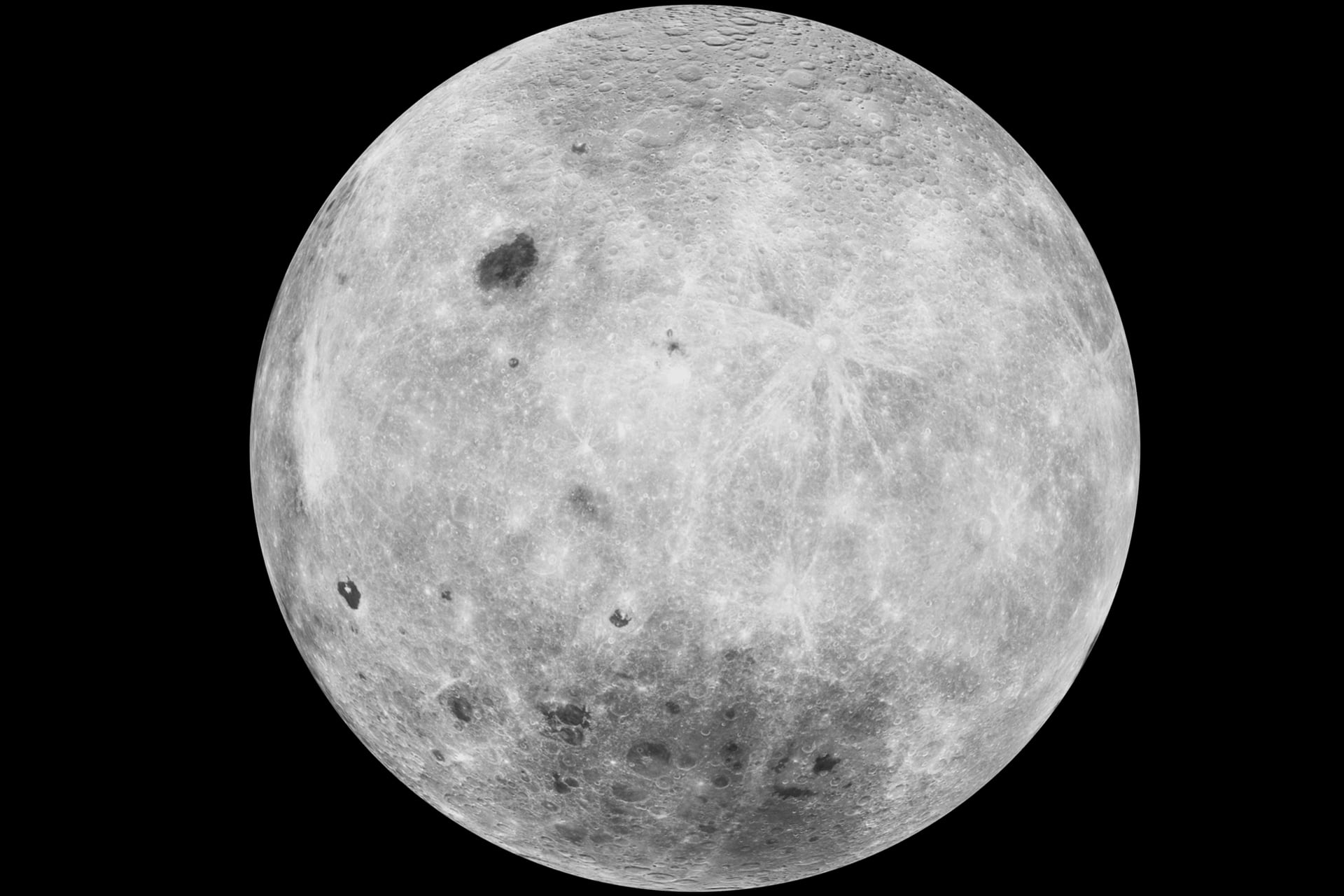
The study tackled a practical question for future exploration: where did the excavated mantle material land? The simulations revealed a butterfly-like ejecta pattern. Mantle material spread roughly 550 kilometers beyond the basin rim in the downrange direction and about 650 kilometers across the sides, with almost none deposited uprange.
That finding matters because NASA's Artemis missions target the Moon's south polar region near the basin's rim. Under older south-to-north impact models, the planned landing region would likely contain little or no mantle ejecta. However, the study authors note that “if a north-to-south impact produced SPA, the Artemis III mission may land within the ejecta deposit that contained excavated mantle material by the SPA-forming impact.”
If astronauts recover mantle-bearing material from the SPA ejecta field, the scientific payoff could be enormous. Researchers could directly study the chemistry of the Moon's deep interior, determine when the giant impact occurred, and better understand how rocky worlds evolved in the early solar system. Samples returned from these regions should reveal the age of SPA and the composition of the lunar mantle.
The work also highlights how planetary scars preserve hidden records of ancient events. Similar giant elliptical basins exist on Mars and even Pluto, meaning the new modeling approach could help reinterpret collisions across the solar system. However, the authors acknowledge that even their advanced simulations cannot capture every fine-scale detail of crustal deformation or ejecta movement. Computer models of impacts this large remain computationally difficult, especially for events billions of years old.
The next phase may not rely on simulations alone. If future Artemis missions return samples from the south polar region, scientists could directly test whether the predicted mantle-rich ejecta is really there.


