Tech & Science
Unveiling Spacetime's Immutable Rules: A New Look at Gravity
Scientists have discovered previously hidden, "frozen-in" rules within Einstein's spacetime, suggesting fundamental constraints on gravity that could revolutionize predictions for extreme cosmic events.
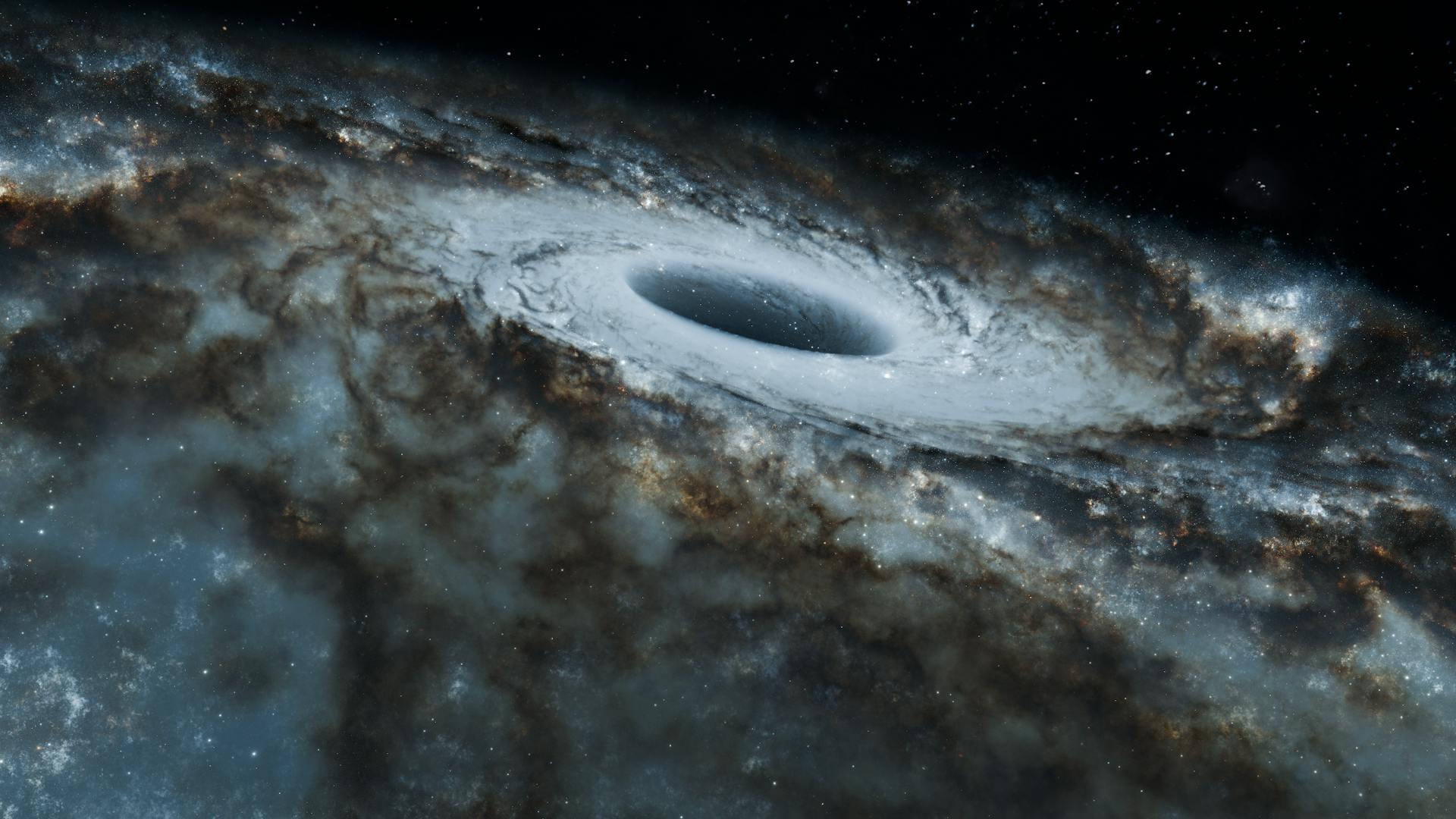
In a groundbreaking development, scientists have identified fundamental, hidden rules governing the evolution of spacetime, challenging previous notions of its unpredictable nature. This discovery offers the first clear evidence that gravity operates under deep, built-in constraints, potentially transforming our understanding of the universe's most extreme phenomena.
The findings suggest that the fabric of the universe, described by Einstein's theory of general relativity as constantly bending and stretching, preserves geometric structures as it evolves. This breakthrough could enable more accurate predictions for complex cosmic events, such as the behavior of orbiting black holes.
“We identified fundamental rules that constrain how spacetime can evolve. These rules act like built-in restrictions on gravity itself, helping us predict how extreme systems such as pairs of orbiting black holes behave when gravity becomes very strong,” said Luca Comisso, a plasma astrophysicist at Columbia University and one of the study’s authors.
If confirmed, this research could significantly alter how scientists approach the study of black hole mergers, gravitational waves, and other high-gravity scenarios, where precise behavioral predictions have historically been a major challenge.
Plasma Physics and Gravity's New Lens
The core of this new study draws inspiration from a principle in plasma physics. In electrically conductive fluids, such as plasmas, magnetic field lines can become "frozen into" the fluid. This means they can move and twist with the fluid but resist breaking or reconnecting, provided certain conditions, similar to Ohm's law, are met.
Comisso and his team explored whether gravity might exhibit analogous behavior. To test this hypothesis, they reformulated Einstein's field equations, which are fundamental to describing gravity, to align with those used in nonlinear electrodynamics. This innovative approach allowed them to conceptualize spacetime as a dynamic medium, akin to a fluid carrying electromagnetic fields.
By treating spacetime in this manner, the researchers were able to apply established concepts from plasma physics directly to the study of how gravitational structures evolve, paving the way for unexpected insights.
Unchanging Structures in Cosmic Evolution
Through their reformulated framework, the study authors discovered that spacetime can host "gravitational field lines"—mathematical constructs that describe the organization of gravity. Crucially, these structures were found to remain connected over time, a phenomenon termed "frozen-in" behavior.
This "frozen-in" state occurs under specific conditions, which are analogous to an ideal version of Ohm's law. The research also identified conserved quantities, including gravitational flux and gravitational helicity. These are topological properties, meaning their essence depends on how structures are interconnected rather than their precise shape, much like a knot in a rope remains a knot regardless of stretching or twisting.
These conserved quantities act as unseen, fundamental rules that spacetime must adhere to as it evolves. This aspect distinguishes the current work from earlier research, which often relied on large-scale simulations with carefully chosen initial conditions to model systems like merging black holes. While valuable, traditional methods do not always reveal universal principles. By pinpointing quantities that remain constant within spacetime itself, this new framework suggests deeper, more general laws governing gravity.
Implications and Future Research
Should these findings be substantiated, they stand to profoundly influence how scientists comprehend the universe's most extreme environments. Systems characterized by intense gravity—such as black holes, neutron stars, and gravitational waves—may follow topological rules that render their behavior more predictable than previously assumed. This enhanced predictability could significantly refine models utilized by observatories like LIGO, Virgo, and the forthcoming LISA mission, which aims to detect gravitational waves from space with heightened sensitivity.
However, the study acknowledges certain limitations. The "frozen-in" behavior is contingent on ideal conditions, which real astrophysical systems may not always perfectly fulfill. Furthermore, the behavior of these structures in more complex environments, where matter and radiation strongly interact with gravity, remains an area requiring further investigation.
Future studies are expected to address these questions and help researchers "understand to what extent the very different phenomena that can occur in plasmas can also happen in non-vacuum spacetime," as noted by the study authors. The research was published in the journal Physical Review Letters, according to Interesting Engineering.
Related articles
Fruit Flies Show Remarkable Hypergravity Resilience, Offering Insights for Space Travel

Breakthrough Panels Produce Hydrogen Fuel Without Electricity

Revolution in Aging Research: Suppressing Cellular 'Emergency System' Paves the Way for Life Extension