AI
AMD Unveils Helion Rack for AI Agents with 32,768 Cores
AMD introduced the Helion computing rack at the Open Compute Project summit, designed specifically to support autonomous AI agents rather than model training.

Advanced Micro Devices has revealed a new hardware architecture named Helion, engineered to host autonomous artificial intelligence agents. The design integrates central processing units and graphics processors within a single rack enclosure, offering enterprises flexibility in infrastructure selection. Unlike uniform solutions for all AI applications, Helion allows data centers to choose configurations based on specific operational needs, including options that rely exclusively on CPUs.
Helion vs. Helios Architecture
According to a report by The Register, AMD announced Helion during the Open Compute Project summit as an addition to its existing computing ecosystem. This new system differs significantly from Helios, which is tailored for large-scale training and inference of AI models. Instead, Helion focuses on providing the necessary infrastructure for independent agents and their associated tasks. The company stated that liquid or air cooling options are available, with partner systems expected to become accessible in November.
Core Specifications and Connectivity
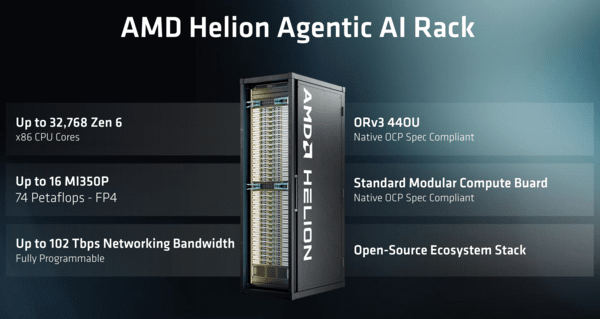
Certain Helion configurations enable access to 32,768 CPU cores using EPYC Venice processors built on the Zen 6 architecture. Other setups can accommodate up to 16 Instinct MI350P GPUs, which are designated for high-performance computing and AI workloads. The announced network bandwidth reaches 102 terabits per second, though specifications vary depending on the chosen configuration. AMD provides a CPU-centric design for agent task execution linked to separate model-running infrastructure, alongside a hybrid option combining both processor types in one rack.
Divergent Computational Demands
The computational requirements for running autonomous agents differ from those needed for training large language models. An agent may need to execute sequential instructions while interacting with tools, software, and databases, rather than solely generating responses from a linguistic model. To address this, AMD offers multiple CPU options, including configurations designed to increase core density and others aimed at boosting performance. These processors deliver capabilities of up to 256 cores per unit.
Latest news

China's Central Bank Extends Gold Buying Streak to 23 Months

$5 Billion in Suspicious Transactions: $1.21 Billion Fines Imposed on Bank of America

Disarming Hamas Begins in Rafah and Khan Younis: 'Trial Plan' Collides with Field Realities