
·
·

Tech & Science
Chinese researchers achieve 30.3% efficiency in rigid perovskite tandem solar cells with 92% retention after 1,000 hours.

A new crystallization control method has pushed all-perovskite tandem solar cells past the 30 percent efficiency threshold while maintaining strong durability, according to a team from the Chinese Academy of Sciences. The rigid devices achieved a certified power conversion efficiency of 30.3 percent, with flexible versions reaching 28 percent.
Ge Ziyi, PhD, and Liu Chang, PhD, led the research at the Ningbo Institute of Materials Technology and Engineering (NIMTE). They believe the breakthrough could accelerate the development of lightweight, high-efficiency solar technologies that are cheaper and simpler to produce than conventional silicon-based panels.
“The findings provide a pathway to simultaneously improve efficiency and durability in both rigid and flexible devices, thereby advancing the development of lightweight, scalable photovoltaic technologies,” the scientists stated.

All-perovskite tandem cells are considered a promising photovoltaic technology because they capture sunlight more efficiently than single-junction cells and can be manufactured using low-temperature solution processing, which lowers costs. However, asynchronous crystallization—where different parts of the multicomponent perovskite films crystallize at different rates during production—has been a major obstacle, creating structural defects and compositional inconsistencies that hurt efficiency and stability.
To solve this, the team applied hard-soft acid-base (HSAB) theory to design an additive strategy. They introduced specific additives into both wide-bandgap and narrow-bandgap perovskite layers to synchronize nucleation and crystal growth. For wide-bandgap perovskites, they used difluoro(oxalato)borate (DFOB⁻) additives, and for narrow-bandgap layers, tetrafluoroborate (BF4⁻).
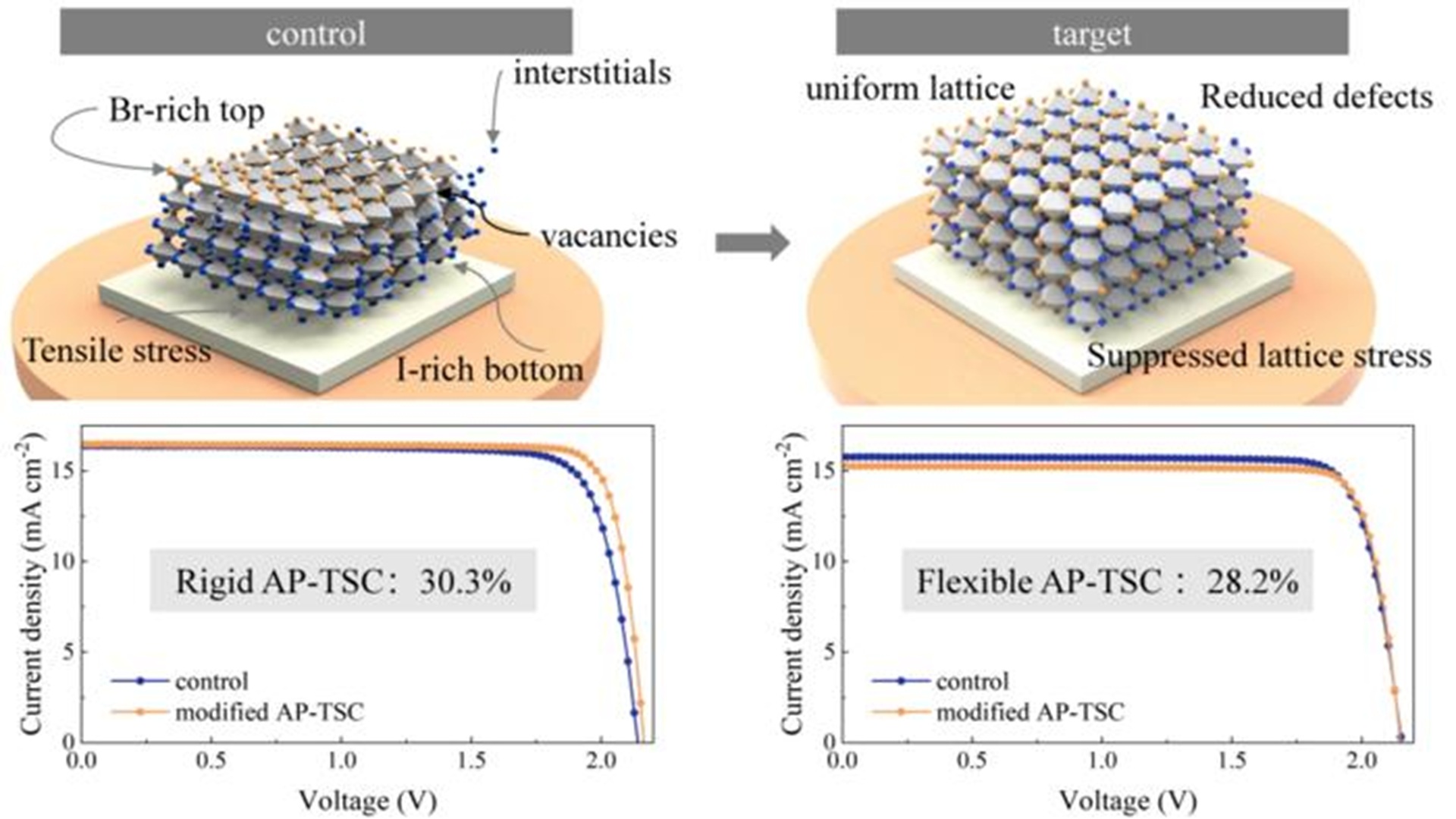
Structural and optical analyses confirmed that the method promoted homogeneous crystal growth and prevented halide redistribution, a common cause of defects and stress accumulation inside the cells. The approach also suppressed uneven vertical phase distribution, improving film uniformity across the devices.
The improvements translated into higher overall performance. Wide-bandgap perovskite solar cells saw efficiency rise from 18.5 to 20.1 percent, while narrow-bandgap devices improved from 21.6 to 23.3 percent. When integrated into monolithic two-terminal tandem architectures, the optimized rigid device reached a peak efficiency of 30.3 percent, with an open-circuit voltage of 2.16 volts and a fill factor of 85.2 percent. Flexible tandem cells also performed well, achieving 28.2 percent efficiency with a certified value of 28.0 percent.
Operational stability, a critical bottleneck for commercial adoption of perovskite solar cells, was also strong. The optimized rigid device retained 92 percent of its initial efficiency after 1,000 hours of maximum power point tracking. Flexible tandems maintained 95.2 percent of their original efficiency after 10,000 bending cycles.
The results point to potential applications in wearable electronics, lightweight power systems, and flexible solar technologies. “This study establishes a general chemical principle for regulating crystallization in compositionally complex perovskite systems,” the researcher concluded in a press release. The findings were published in the journal Nature Nanotechnology.


