·
·


Tech & Science
A dormant black hole with a mass six billion times that of the Sun has been detected in galaxy MRG-M0138, located over 10 billion light-years from Earth.

A black hole with a mass approximately six billion times that of the Sun has been observed in the galaxy MRG-M0138, situated more than 10 billion light-years from Earth. This dormant black hole represents the most distant such object ever identified, dating back to when the universe was about 3 billion years old.
The discovery, published in Science, was made by an international group of scientists including members from UCL. It surpasses the previous record for the farthest dormant black hole by a factor of 15. The finding offers a unique opportunity to study the development of massive black holes and their host galaxies during the early stages of cosmic history.
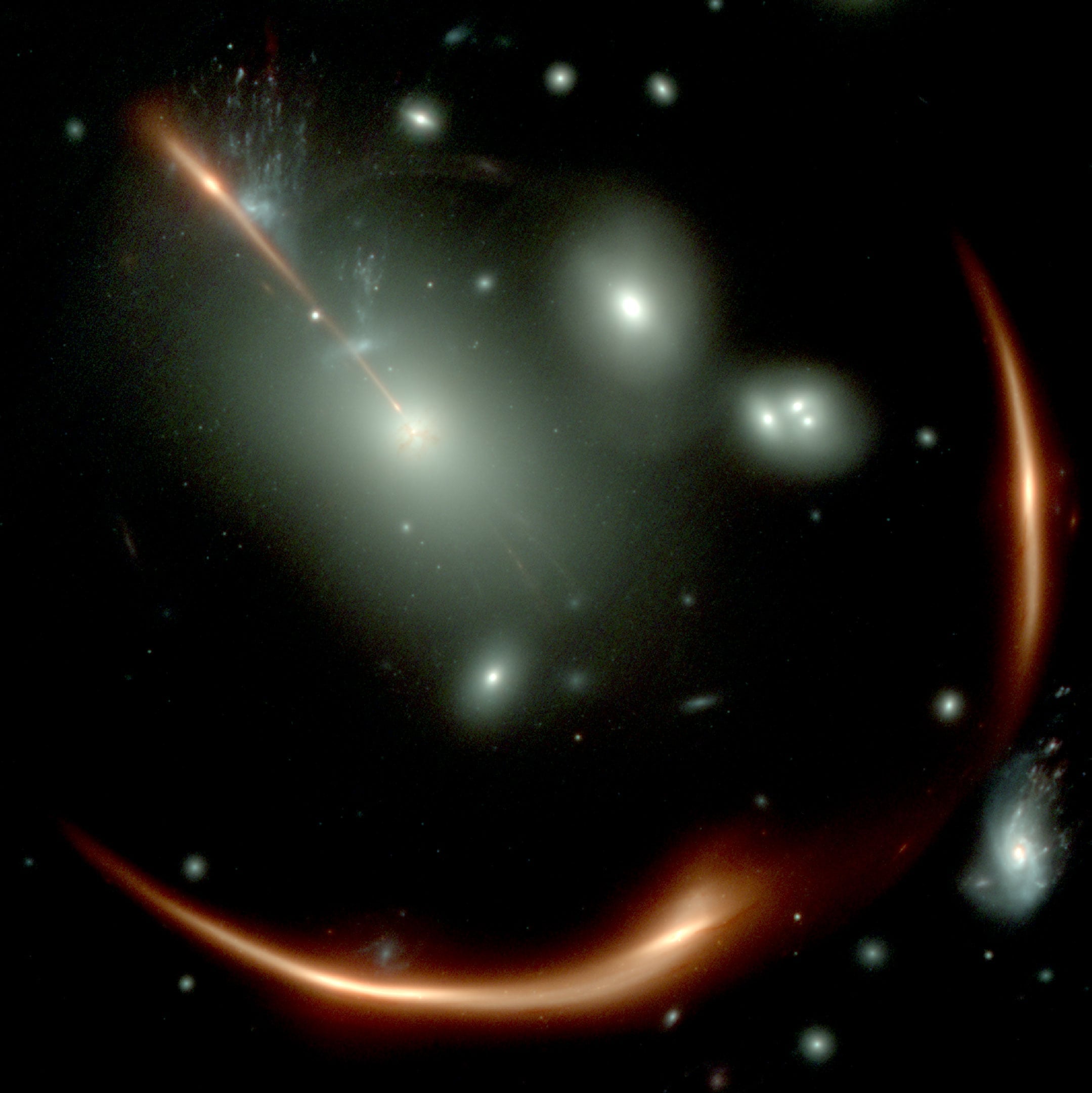
Highly Distorted Red Galaxy MRG M0138
Researchers employed data from NASA’s James Webb Space Telescope (JWST) to analyze the motion of stars orbiting the black hole, which itself emits no light. This method, known as stellar dynamics, has been previously used to measure dormant black holes in nearby galaxies but is applied here for the first time at such an extreme cosmological distance.
Professor Richard Ellis from UCL Physics & Astronomy, the senior author, explained that by tracking how stars move collectively within the galaxy’s core, the team could determine the black hole’s mass despite its invisibility. He noted this approach enables a more comprehensive understanding of black hole growth over time and their influence on galaxy evolution.
Unlike active black holes that emit bright radiation due to infalling gas, the supermassive black hole in MRG-M0138 is inactive, with no current gas accretion. Its presence was confirmed solely by observing the gravitational effects on nearby stars. Variations in stellar velocities near the galaxy’s center compared to those farther out provided the necessary data to calculate the black hole’s mass.
This technique parallels methods used to estimate the mass of the Milky Way’s central black hole and others in closer galaxies. However, prior to this, the most distant galaxy studied with stellar dynamics was about 700 million light-years away.
The team overcame the challenge of observing such a distant galaxy by utilizing gravitational lensing, where a foreground galaxy bends and magnifies the light from MRG-M0138 by a factor of 30. This cosmic magnification allowed detailed reconstruction of the galaxy’s internal structure and the region influenced by the black hole’s gravity.
Dr. Andrew Newman, lead author from Carnegie Science, stated that combining JWST observations with gravitational lensing permitted the team to examine the black hole’s sphere of influence, where its gravity increases stellar speeds. He emphasized this as one of the best available methods to weigh black holes, now extended to an earlier epoch in the universe.
The discovery sheds light on the co-evolution of galaxies and their central black holes in the early universe. While studies of nearby galaxies have shown a correlation between galaxy mass and black hole mass, data from earlier cosmic times are needed to understand how this relationship formed.
The researchers found both the black hole and its host galaxy to be inactive, with no ongoing star formation. This suggests that MRG-M0138 might have previously harbored a bright quasar phase. It is hypothesized that energy released during rapid black hole growth either heated or expelled the gas necessary for star formation, effectively halting the process.
Future observations using JWST and other space telescopes are expected to identify more dormant black holes from the early universe. These findings could provide further insight into how black holes suppress star formation and the conditions under which dormant black holes become active again when new material accretes.
Reference: “A stellar dynamical mass measurement of an inactive black hole at redshift 2” by Andrew B. Newman, Meng Gu, Sirio Belli, Richard S. Ellis, Sai Gangula, Jenny E. Greene, Jonelle L. Walsh, Sherry H. Suyu, Sebastian Ertl, Gabriel Caminha, Giovanni Granata, Claudio Grillo, Stefan Schuldt, Tania M. Barone, Simeon Bird, Karl Glazebrook, Marziye Jafariyazani, Mariska Kriek, Allison Matthews, Takahiro Morishita, Themiya Nanayakkara, Justin D. R. Pierel, Ana Acebrón, Pietro Bergamini, Sangjun Cha, Jose M. Diego, Nicholas Foo, Brenda Frye, Yoshinobu Fudamoto, M. James Jee, Patrick S. Kamieneski, Anton M. Koekemoer, Asish K. Meena, Shun Nishida, Masamune Oguri, Piero Rosati and Adi Zitrin, 4 June 2026, Science. DOI: 10.1126/science.adx5816