Tech & Science
ESA Hera reveals chaotic spin and crater on Dimorphos after DART impact
First close-up images from ESA's Hera mission show a massive crater and unstable rotation on asteroid Dimorphos following the 2022 NASA DART collision.

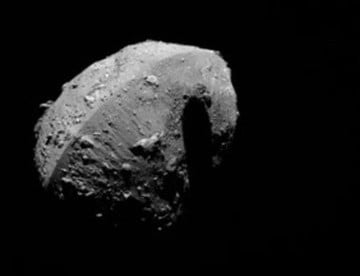
The first close-range imagery captured by the European Space Agency’s Hera mission has confirmed significant physical alterations to the asteroid Dimorphos resulting from NASA’s deliberate DART spacecraft impact in September 2022. These initial visuals demonstrate that the collision notably changed the shape of the celestial body, revealing a large crater spanning nearly the entire width of the asteroid, which measures approximately 151 meters in diameter.
Hera captures impact aftermath
Surface deformations are clearly visible on the side of Dimorphos struck by the probe, while the opposite hemisphere shows no substantial changes. The data indicates that the event did more than excavate a crater; it also disrupted the asteroid’s rotation, causing it to move chaotically within its orbit around the larger companion body, Didymos. Patrick Michel, the principal investigator for the Hera mission, stated that these findings contradict many prior expectations, noting that the asteroid was affected simultaneously by three distinct factors: an impact crater, a change in shape, and unstable spinning.
Orbital shift and debris field
In 2022, NASA’s DART mission shortened Dimorphos’s orbital period around Didymos by roughly 33 minutes. While Earth-based telescopes detected this orbital change, they could not observe the direct physical consequences on the asteroid itself. Hera, having traveled for two years to reach the system, is now providing that missing visual context. Additionally, the mission has identified hundreds of large rocks surrounding the binary asteroid system, some of which may be remnants of the collision. Scientists are currently working to pinpoint the exact origin of these boulders to better understand the post-impact environment.
Planetary defense implications
The DART experiment targeted the Didymos-Dimorphos binary system as the first practical test of kinetic deflection technology, a method viewed as a potential means to protect Earth from future threats. Hera continues to analyze data collected since its arrival at the site. Over the coming months, the mission plans to approach closer to obtain higher-resolution images and study Dimorphos’s internal structure, mass, and physical properties. A primary objective remains assessing the efficiency of momentum transfer from the spacecraft to the asteroid, a critical factor in determining the viability of this technique for altering the trajectories of hazardous space objects.
Latest news

Revolution in the Public Sector: Launch of EU-Funded 'Reference Framework for Job and Competency Description'

Jordanian sailor’s body recovered near UAE coast after tanker attack

Khamenei Calls for Renewal of Basij Organization and Revival of Its Revolutionary Spirit