·
·


Tech & Science
New research reveals Martian polar ice is significantly cleaner than previously estimated, altering understanding of climate history and potential habitability.

Only about 3% of the mass in the upper layers of ice at Mars’ north pole consists of dust, according to a study published September 8 in npj Space Exploration. This figure is drastically lower than earlier estimates suggesting up to 25% dust content, indicating that the frozen deposits are far cleaner than scientists previously believed.
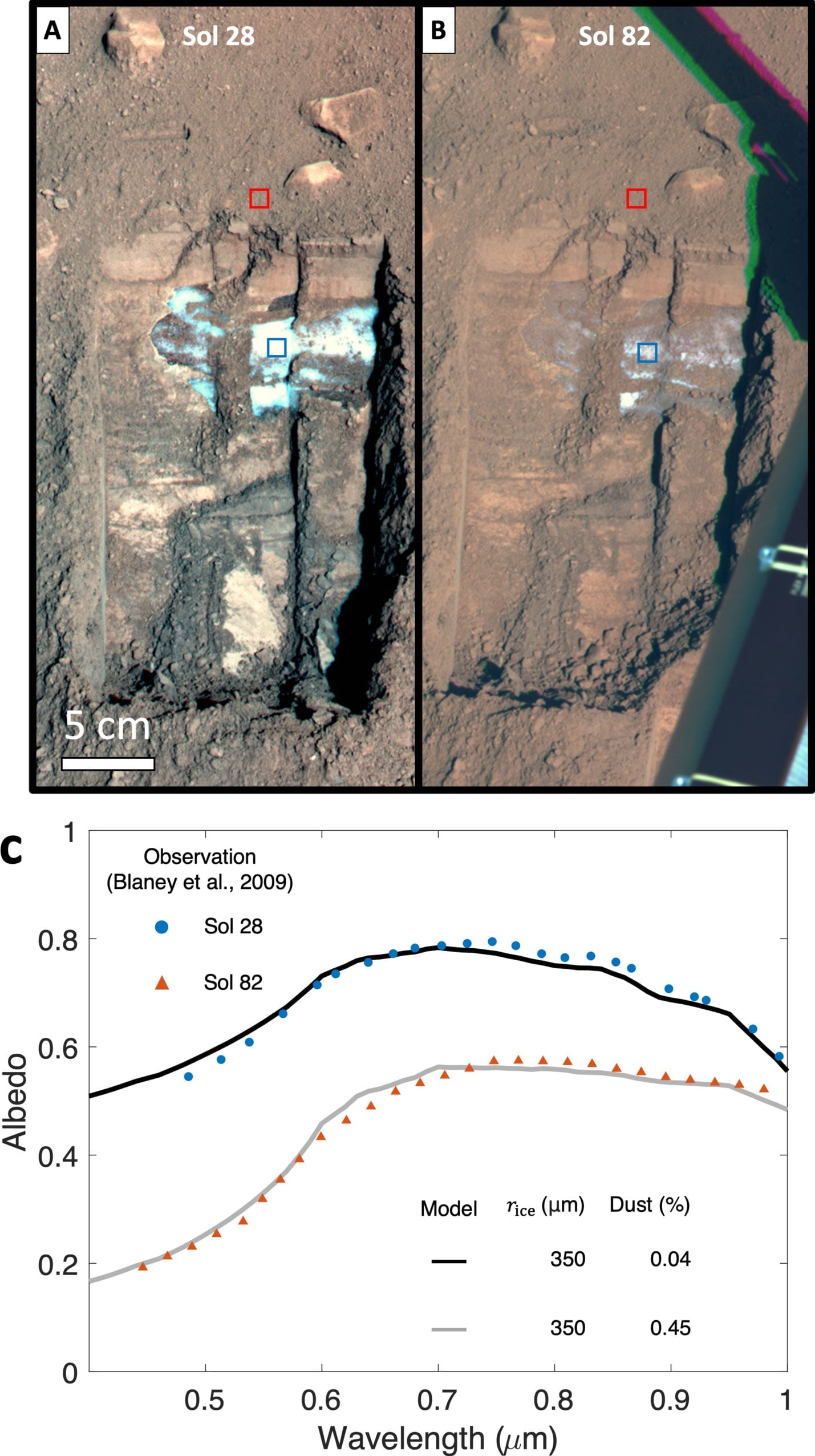
Mars Dust Content Comparison Over 58 Sols
Unlike Earth, which maintains a steady posture due to its massive moon, Mars oscillates wildly because it is tugged only by two tiny moons. Aditya Khuller, a research scientist at the University of Washington, explained that this axial instability drives extreme ice ages, leaving roughly one-third of the planet buried under shallow layers of frozen water.
These deposits function as an archive of ancient climate conditions, trapping falling dust and atmospheric gases similar to how tree rings record rainfall. However, direct sampling remains challenging; NASA lost the Mars Polar Lander near the south pole in 1999, while the Phoenix mission successfully sampled ice near the north pole in 2008.
Most water ice at the north pole lies hidden beneath a dusty surface rather than being exposed. This dust darkens the ice, reducing sunlight reflection and accelerating warming and vaporization. “If it is dustier, the ice will be darker,” Khuller said. “Just like a dark T-shirt in the sun makes you warmer, dusty ice gets warmer and vaporizes faster on Mars.”
Prior calculations relied on methods originally developed for lunar soil analysis. Khuller identified discrepancies when testing these approaches under Earth conditions. To address this, he collaborated with Pari Mohan, a recent geoscience graduate from the University of Washington, who recalculated ice properties using techniques adapted from Steve Warren, a UW professor emeritus specializing in snow and ice.
By combining Phoenix mission observations with satellite measurements, the researchers determined the actual dust content was closer to 3%. Seasonal brightness changes also revealed that the ice is not uniformly dirty but stacked “like an ice-cream sandwich,” with dustier layers situated between slabs of cleaner ice.
A relatively dusty frost forms over the surface each winter. When summer arrives, this seasonal layer disappears, exposing older, cleaner ice underneath. “By looking at how the brightness changed over time, we figured out that there is a frost that forms in the winter and it’s more dusty,” Khuller said. “In the Martian summer it goes away, exposing cleaner, older ice.”
The preserved layers may hold evidence of conditions thousands of years ago, when researchers believe the ice accumulated through snowfall. Each layer offers clues to how the Martian climate shifted during its dramatic ice age cycles. Additionally, the mix of dust and ice influences whether small pockets of liquid water could form below the surface.
Khuller and colleagues previously proposed that darker dusty layers could absorb sunlight and trap enough heat to melt surrounding ice. Dust within these pockets might supply nutrients, potentially creating environments suitable for bacteria or other primitive life forms. On Earth, similar shallow, dusty meltwater pockets teem with life during summer, with microbes becoming dormant when winter freezes the water.
“The fact that Mars and Earth both have these similar layers of water ice and dust is interesting,” Khuller said. “Why does one planet have life and the other doesn’t?” Khuller hopes to apply this improved analysis to other regions of Mars to build a clearer record of the planet’s climate evolution.