·
·


Tech & Science
Mars Express's HRSC camera captured metallic-like sand dunes in the ancient Noachis Terra region, showcasing dynamic Martian landscapes shaped by wind and water.

Sand dunes forming part of an ancient and unique field sculpted by wind on Mars are visible in recent images. These dunes are located on the surface of the Red Planet and represent a segment of a rare geological formation.
The images were taken by the high-resolution stereo camera (HRSC) aboard the Mars Express probe. They focus on one of the oldest regions on Mars known as Noachis Terra or "Noah's Land," situated in the planet's ancient southern highlands. This area has endured intense bombardment by meteoroids and asteroids over the past four billion years, with the impact scars clearly visible.
Dominating the right half of the image is a portion of the floor of the massive Kaiser Crater, a large basin approximately 180 kilometers in diameter and several kilometers deep.
To the left side of the image, a wide array of smaller craters is scattered, some featuring sharp rims while others show gradual erosion over time.
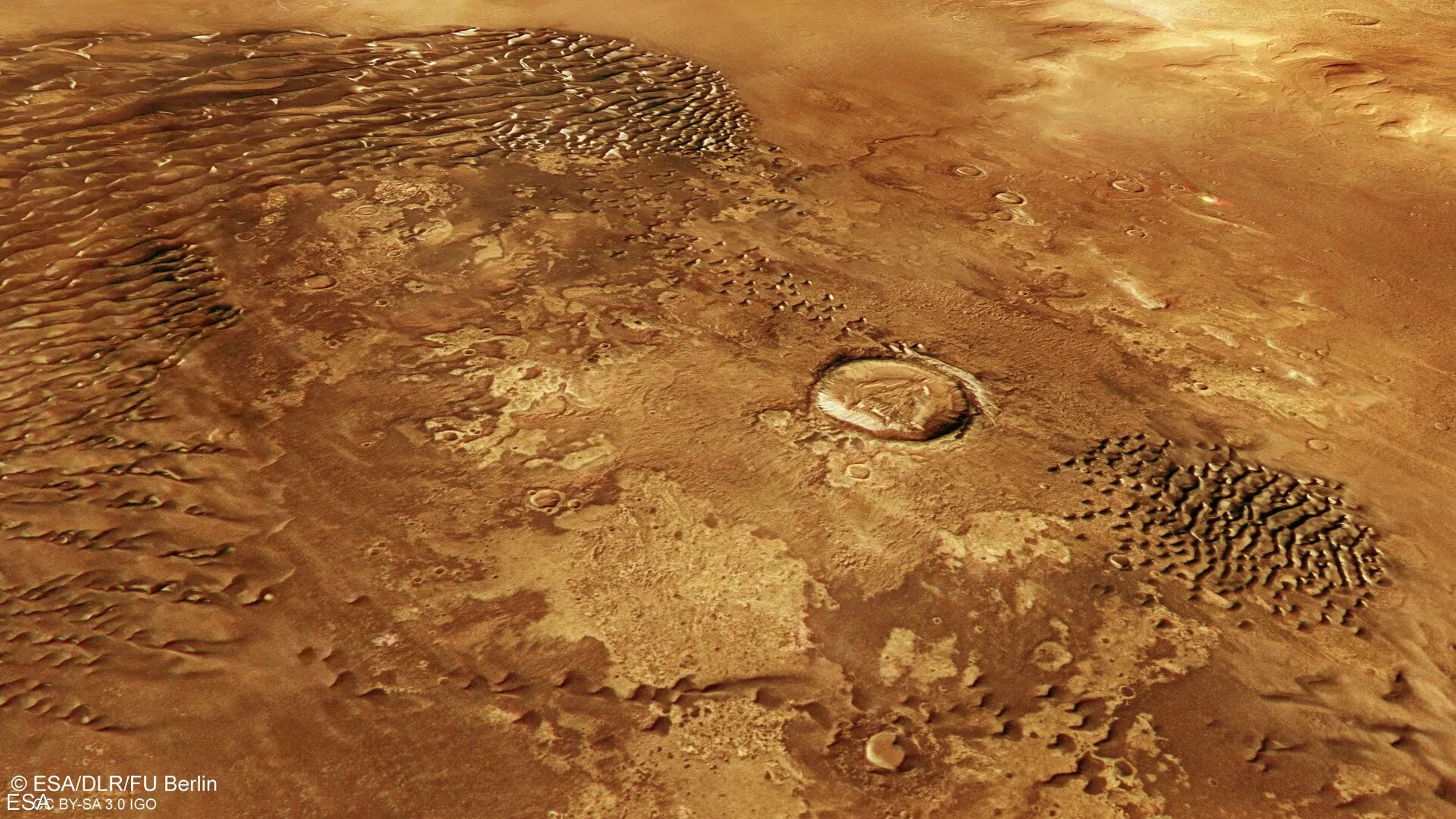
A significant part of the Kaiser Crater floor is covered by distinctive dark dunes that appear almost metallic and shiny. These are sand dune hills sculpted by Martian winds, rising over 100 meters above the surrounding surface.
The metallic sheen is attributed to deposits of bright frost on the south-facing slopes of the dunes. This sand field consists of a combination of transverse dunes and barchan dunes, the latter being the most common dune type on Mars.
Transverse dunes are more elongated and evenly spaced and can develop as sand accumulates on barchan dunes. Both dune types form through the accumulation and transport of sand by winds blowing predominantly from the west in this region of Mars, pushing and shaping these distinctive wave-like peaks.
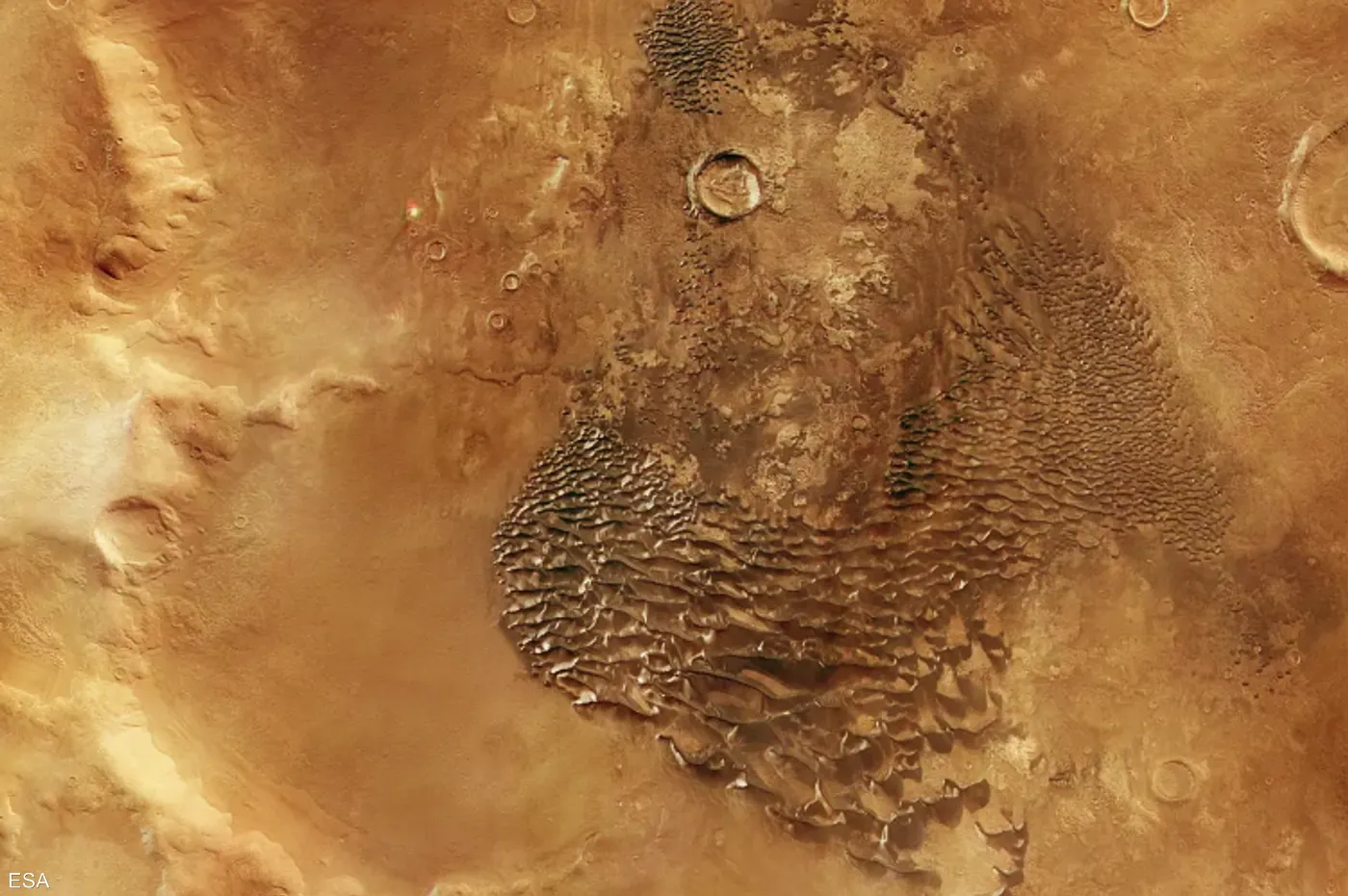
The sand itself is fine and basaltic, rich in minerals such as pyroxene and olivine, which are volcanic in origin. The sand is constantly moving, causing these dynamic landforms to slowly evolve over time.
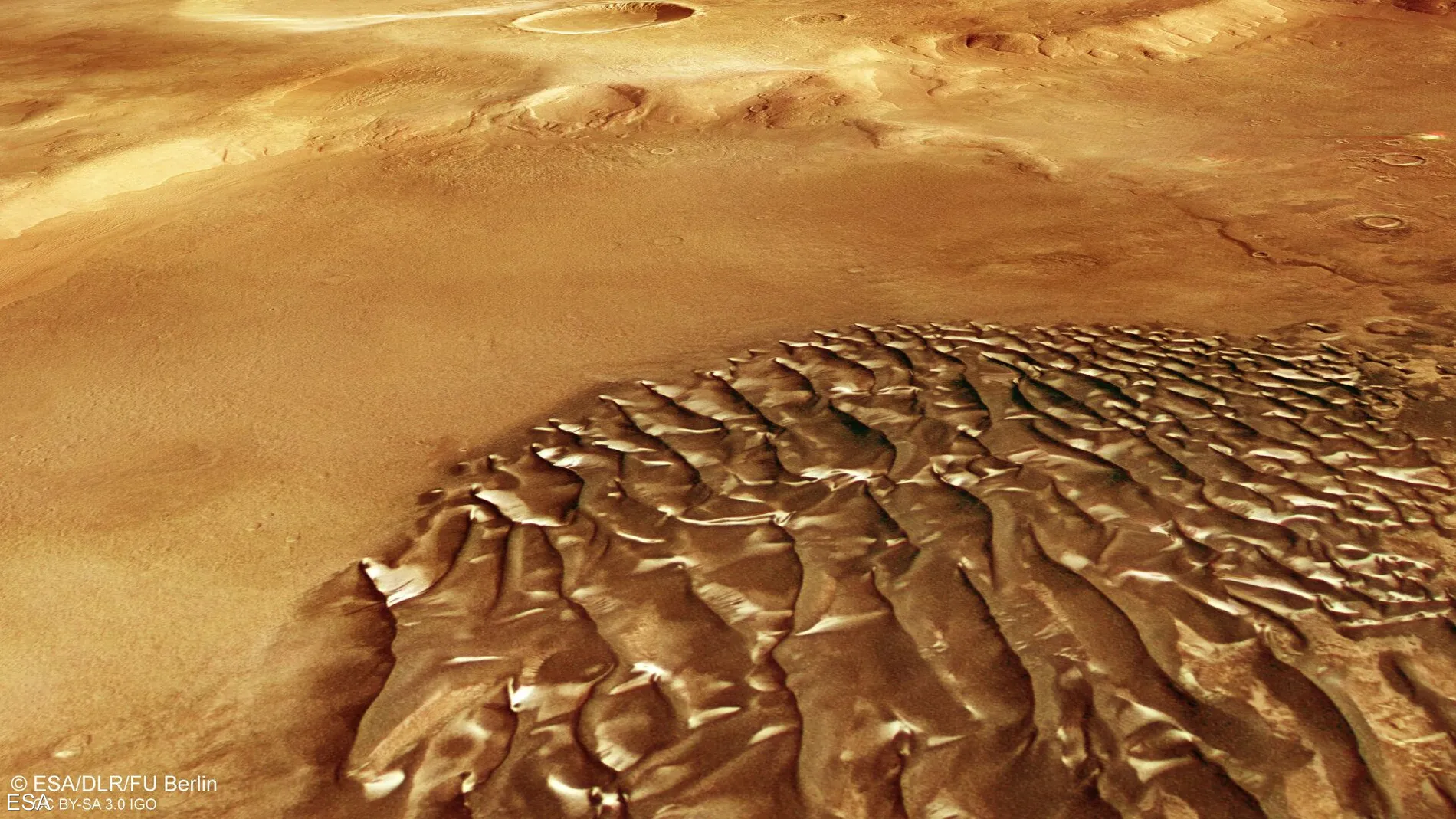
The image was captured by the HRSC camera, one of eight cameras onboard the Mars Express probe launched in 2003. Mars Express has continuously imaged and studied Mars's varied terrain, producing highly detailed, color, and three-dimensional maps of the planet's surface over more than two decades.
This extensive mapping effort has provided insights that have fundamentally transformed scientific understanding of Mars.