·
·


World
President Trump has postponed a major military strike against Iran following intense pressure from allies, yet the Pentagon continues to keep forces in the Gulf and Middle East at maximum combat readiness. Experts describe the situation as a tense standoff with diplomatic efforts ongoing amid heightened military vigilance.
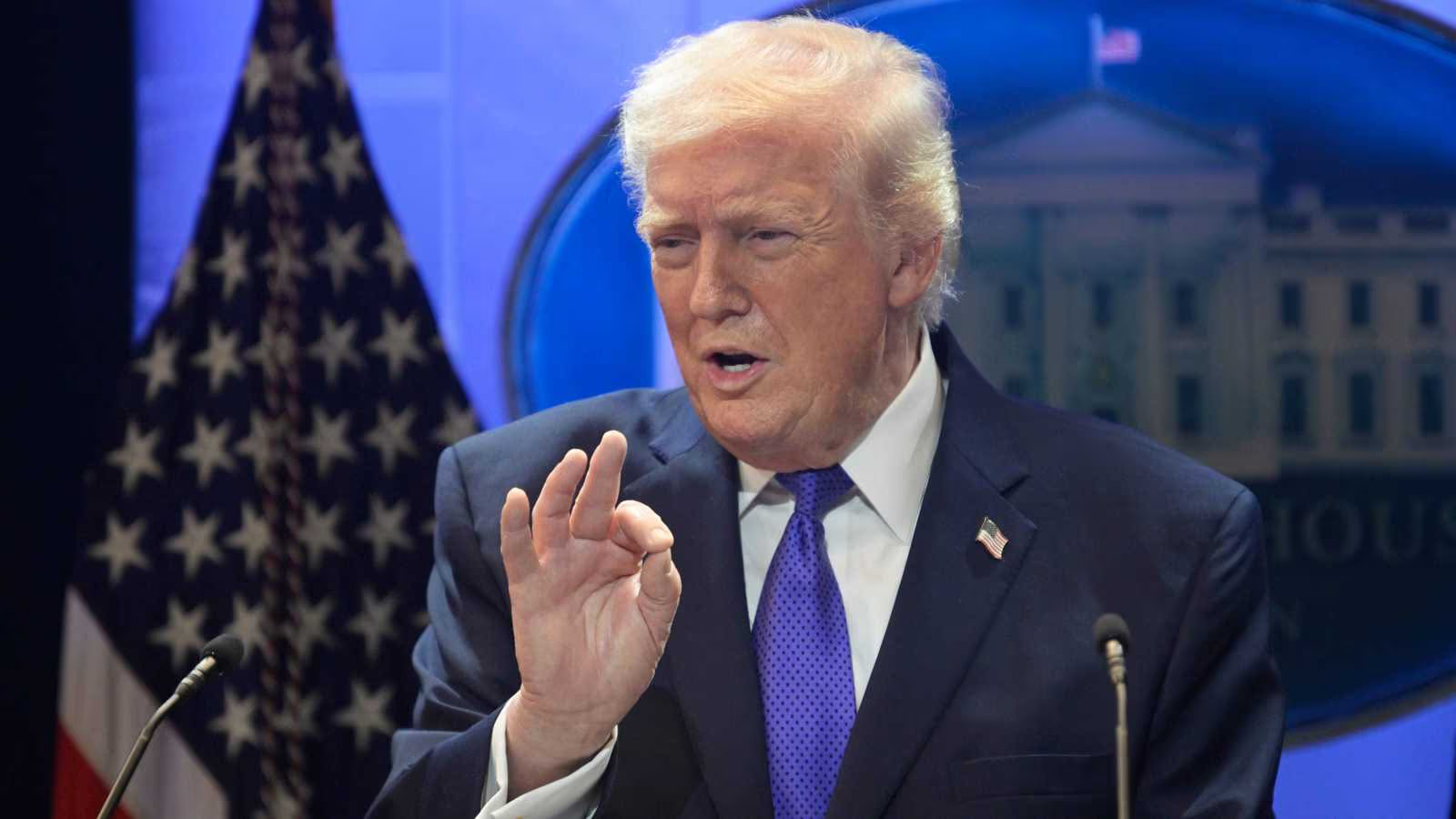
The escalating tension between Washington and Tehran took a dramatic turn after President Donald Trump officially announced the postponement of a large-scale military attack planned against Iran. This decision came as a direct response to strong appeals from regional and international allies urging a final diplomatic effort.
Despite the political retreat, the U.S. Department of Defense has maintained all its military bases and installations across the Gulf and broader Middle East on the highest state of combat alert. Analysts interpret this sustained air and naval readiness, enforced by U.S. Central Command (CENTCOM), as a demonstration of "hot readiness" to respond instantly to any threats.
Defense experts highlight that American air defense systems, including Patriot and THAAD batteries, along with command centers, remain poised to react within seconds. This posture aims to establish a secure military safety net against potential preemptive or retaliatory strikes from Tehran or its allied factions during the temporary freeze on offensive operations.
The Pentagon has recently implemented operational adjustments, such as relocating exposed combat units to remote command centers, while simultaneously sustaining the largest naval and aerial assembly in the region in decades. This buildup features three carrier strike groups led by supercarriers like the USS Gerald Ford and USS Abraham Lincoln, supported by squadrons of fifth-generation fighters including F-22 and F-35 jets, all ready to launch immediately once the political delay expires.
Reports from international research institutions and satellite imagery, including a study by the Center for Strategic and International Studies (CSIS), have documented that missile and drone attacks launched by Iran and its allies in the early weeks of the conflict damaged over 17 U.S. military facilities.
The American response has extended beyond defensive fortifications to an offensive mobilization unmatched since the 2003 Iraq invasion. Retired Major General Hisham Ahmed interprets Trump's decision to delay the strike as a calculated psychological tactic aimed at pressuring Iranian leadership to reconsider their stance.
“The simultaneous announcement of the strike delay and the Pentagon’s continued military alertness reveals a precise division of roles between the White House and the Pentagon in managing the conflict with Iran,” Ahmed stated.
He further explained that while Trump offers a last political opportunity, military commanders on the ground view the postponement period as extremely precarious due to the risk of surprise operations by the Iranian Revolutionary Guard designed to disrupt the U.S. attack plans.
Political analyst Dr. Hussein Abu Warda noted that diplomatic talks facilitated by Islamabad face complex obstacles, largely due to American conditions Tehran describes as "onerous." These demands include full political and nuclear concessions without an immediate lifting of the naval blockade on Iranian ports.
Abu Warda characterized the current situation in the Middle East as a conditional ceasefire maintained under the threat of imminent conflict. He remarked that although Trump has temporarily "disarmed the detonator" at the behest of allies, the Pentagon’s persistent maximum alert status signals that the region remains perilously close to the brink.
He added that the forthcoming hours will be decisive in determining whether diplomacy can resolve the crisis or if military force will ultimately dictate the outcome.
Meanwhile, the Strait of Hormuz and international energy corridors continue to face the threat of complete closure. Warnings persist that any armed confrontation between the U.S. naval forces on high alert and Iranian maritime units could reignite hostilities at any moment.
Additionally, Iranian officials attributed recent explosions on Qeshm Island to the dismantling of unexploded ordnance, according to a statement reported by Tasnim News Agency.