·
·


Culture & Society
Researchers found that tectonic stress along Southern California’s San Andreas and San Jacinto faults has reached unprecedented levels over the past 1,000 years.

For over a century and a half, the major faults of Southern California have been accumulating tectonic energy beneath the surface, with the San Andreas and San Jacinto fault systems playing a central role. Despite frequent minor tremors, the region has experienced extended periods of seismic quiet, during which stress steadily builds along these faults.
The San Andreas and San Jacinto faults converge near Cajon Pass northeast of Los Angeles, forming a geologically intricate junction. Scientists have long studied this area because a rupture on one fault might propagate onto the other, amplifying seismic risk.
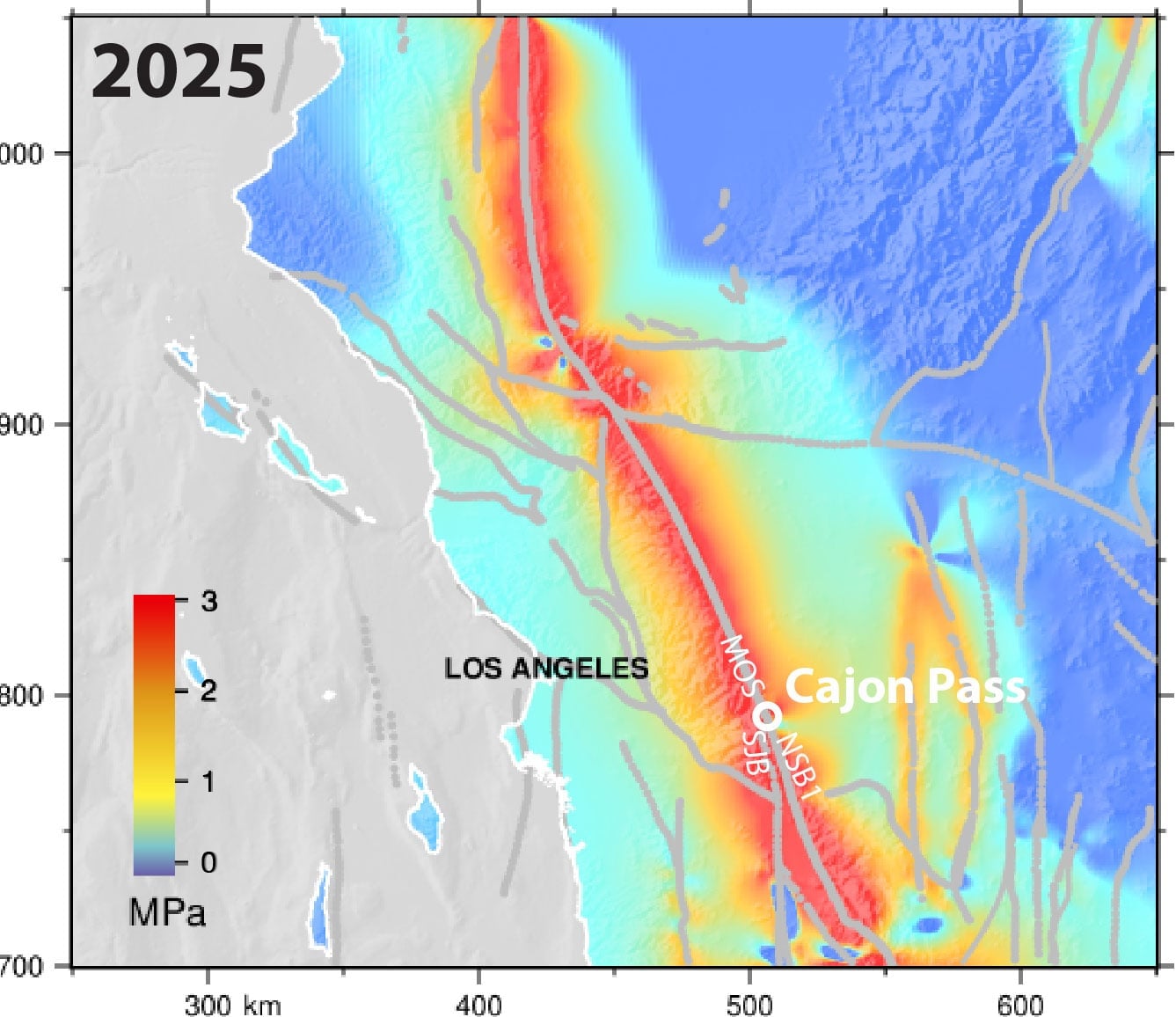
2025 Coulomb Stress Map of Southern San Andreas Fault
The last significant earthquake affecting the greater Los Angeles area was the magnitude 7.9 Fort Tejon event in 1857. Since then, stress accumulation along these fault segments has continued, producing a prolonged quiet interval that has raised concerns among researchers.
Dr. Liliane Burkhard, from the Division of Space Research and Planetary Sciences at the University of Bern’s Physics Institute, led a new investigation modeling 1,000 years of earthquake activity on the southern San Andreas and San Jacinto faults to assess current stress levels at Cajon Pass. The international team also included experts from the University of Hawaiʻi at Mānoa, the U.S. Geological Survey Earthquake Science Center in Pasadena, and the Scripps Institution of Oceanography at UC San Diego.
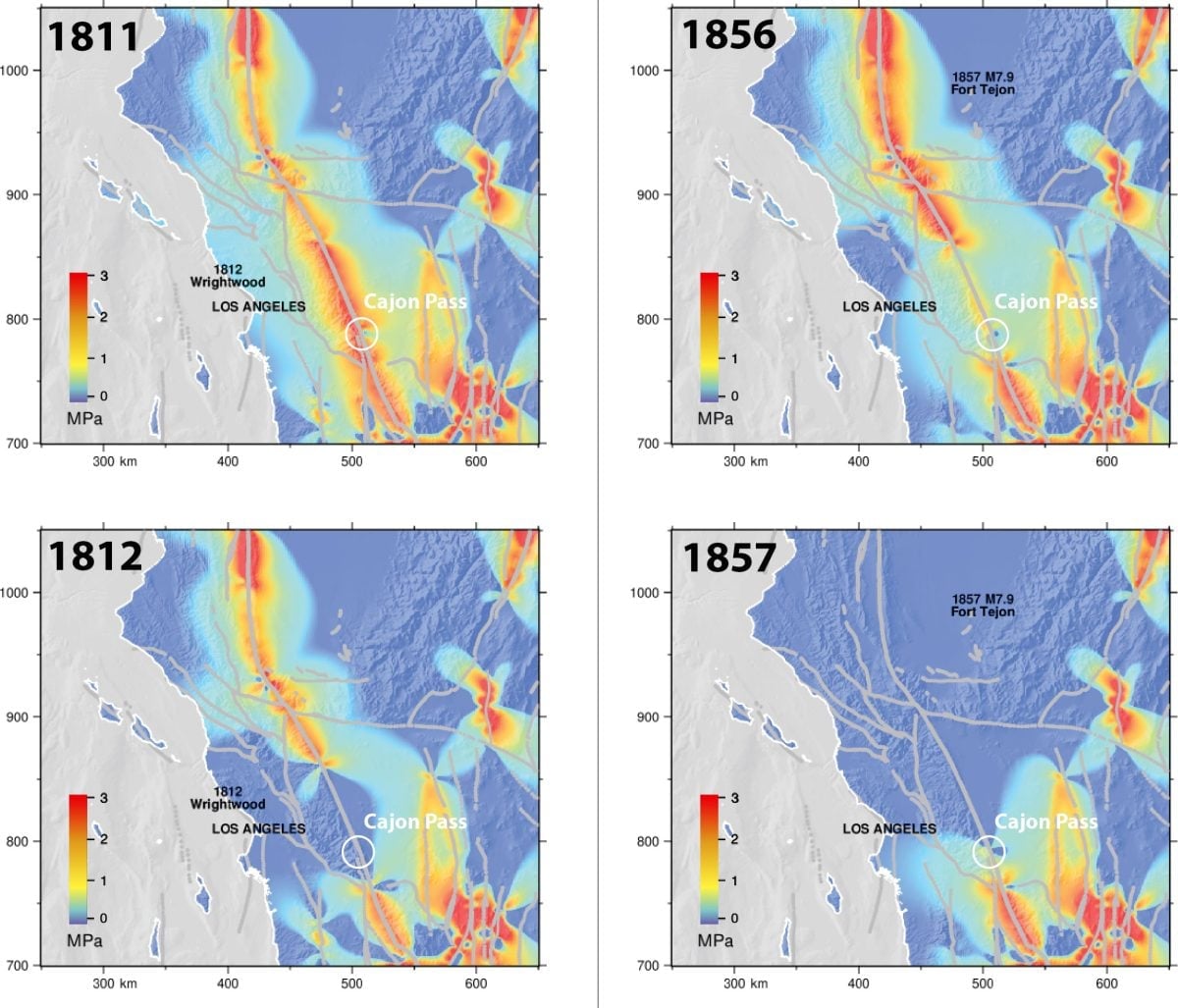
Coulomb Stress Evolution Across Southern San Andreas Fault Segments
The study’s results reveal that tectonic stress in this region has reached or exceeded the highest levels recorded in the past millennium. It further characterizes Cajon Pass as an “earthquake gate,” a fault junction that influences whether a large earthquake remains confined to one fault or extends across both systems. The research was published in the Journal of Geophysical Research: Solid Earth.
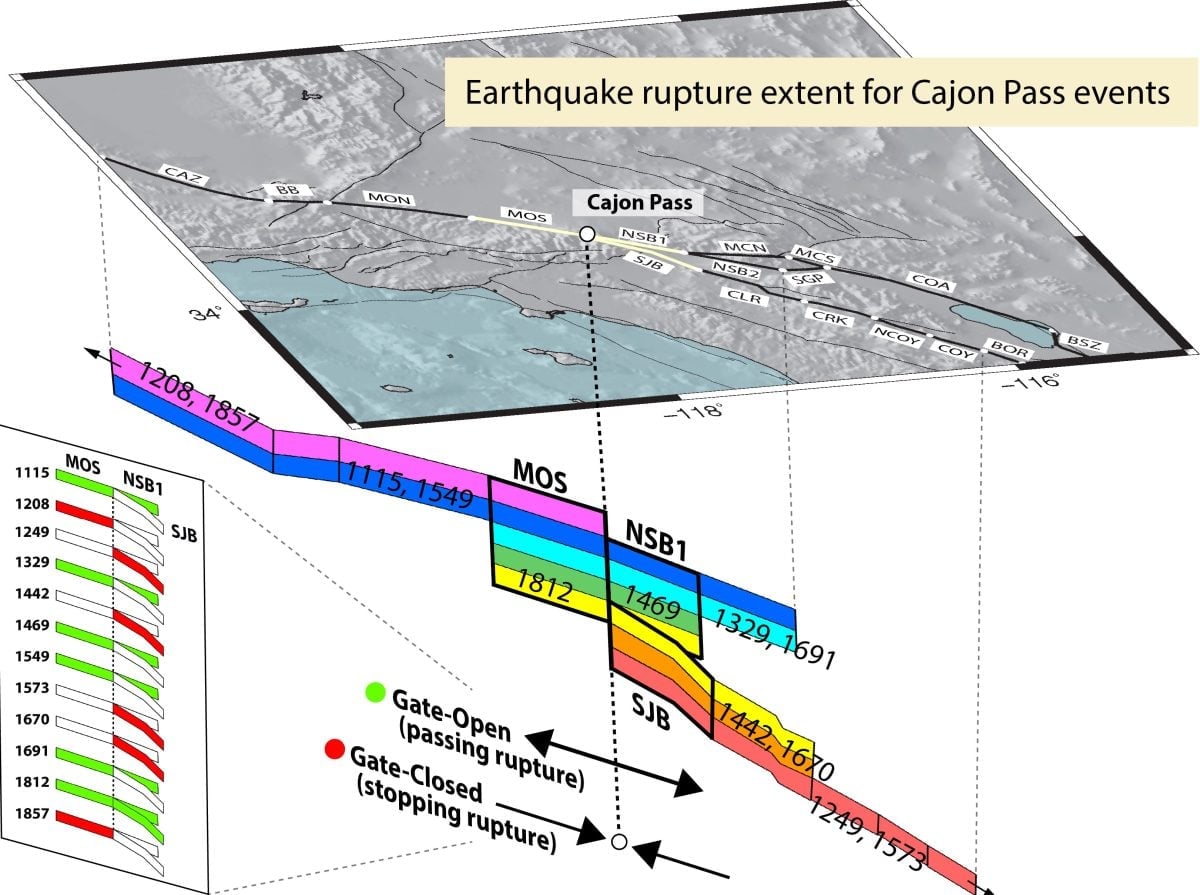
Earthquake Rupture Extent at Cajon Pass
The researchers developed a four-dimensional physics-based earthquake cycle model, simulating three spatial dimensions plus time, to track stress changes along the San Andreas and San Jacinto faults and at the Cajon Pass junction. This model incorporated a reconstructed 1,000-year earthquake record derived from geological evidence such as radiocarbon dating, tree ring anomalies, and historical ground rupture documentation.
Burkhard explained that the model monitors how each earthquake alters stress on adjacent fault segments, how stress accumulates during quiet periods between events, and how deeper crustal layers gradually relax after major ruptures. She noted, “By running the earthquake history of Southern California as a simulation, we can estimate the extent to which the fault system is already under stress today.” The team’s findings indicate that current stress levels are the highest in the last 1,000 years.
A key conclusion of the study is that Cajon Pass functions as an “earthquake gate,” a junction that determines whether a major rupture halts on one fault or continues across both. Historical earthquakes demonstrate both behaviors: the 1857 Fort Tejon earthquake stopped at Cajon Pass without rupturing the San Jacinto Fault, whereas the 1812 Wrightwood earthquake passed through the junction, rupturing both fault systems in a single event.
Burkhard remarked, “The earthquake gate concept captures something important about how fault junctions work. Cajon Pass doesn’t simply block or channel earthquakes: It responds to stress conditions, and those conditions change over centuries.”
The study highlights that the critical factor is not only the magnitude of stress on individual faults but also whether stress levels on both fault systems rise concurrently. When both faults experience high and similar stress, conditions favor a large rupture spanning both systems. Conversely, asynchronous stress levels tend to cause ruptures to stop at the junction.
The model estimates a stress of 3.6 MPa on the San Jacinto-Bernardino section, exceeding any value in the 1,000-year simulation, and 2.8 MPa on the Mojave South section of the San Andreas fault. Both segments are highly stressed and exhibit comparable stress levels, a pattern historically preceding joint ruptures.
Burkhard stated, “It is concerning not only that stresses are reaching historic highs but also that the relative stress conditions between the two fault systems approach levels associated with major ruptures crossing both faults simultaneously—a scenario with much larger consequences for the region.”
A rupture passing through Cajon Pass involving both the San Andreas and San Jacinto faults would be significantly more severe than an earthquake limited to a single fault. The affected area includes densely populated and infrastructure-critical corridors such as greater Los Angeles, San Bernardino, Riverside, and the Coachella Valley. Cajon Pass itself accommodates major highways, rail lines, and energy infrastructure.
Burkhard noted, “Determining when and how the next major earthquake will occur here is one of the most pressing challenges in applied geoscience. Our results offer a clearer, physics-based understanding of the current stress state of the fault system. Moreover, the framework developed applies not only to California but also to other complex fault junctions worldwide.”
She emphasized, “This study does not predict when an earthquake will happen. Rather, it shows that the system is critically stressed, and physics-based models like ours provide a clearer picture of the range of scenarios for which preparation is necessary. This information is vital for hazard assessment, infrastructure planning, and emergency preparedness.”
The research, titled “Cajon Pass and the Southern San Andreas Fault System: Earthquake Cycle Stress Accumulation and Present-Day Loading,” was authored by Liliane M. L. Burkhard, Bridget R. Smith-Konter, Katherine M. Scharer, and David T. Sandwell and published on 3 June 2026 in the Journal of Geophysical Research: Solid Earth (DOI: 10.1029/2025JB033213).
This study received support from the Statewide California Earthquake Center (Contribution No. 15025) through awards 17169, 18149, and 19161, funded by NSF Cooperative Agreement EAR-2225216 and USGS Cooperative Agreement G24AC00072. Additional funding came from NSF EarthScope awards EAR-0847499 and EAR-1614875 and NASA Earth Surface and Interior Program awards 80NSSC19K1043 and 80NSSC23K0744. The research is SOEST contribution #12140.