Lebanon
Trillions of Liras and the Future of Electricity: What Parliament Has Approved So Far
Lebanon's parliament approved key financial agreements with Turkey and the World Bank, alongside massive supplementary budgets for electricity debts and public transport subsidies.

At Place de l'Etoile, the legislative session began at eleven o'clock, comprising 31 items distributed across financial, economic, developmental, administrative, and legislative files. The agenda includes several issues ranging from international agreements and loans to additional appropriations and the settlement of various employment and social cases.
The House of Representatives approved the military-financial cooperation agreement and the cash support protocol between Lebanon and Turkey.
It also approved Law No. 3139, which authorizes the Lebanese government to conclude an air services transport agreement between the Government of the Lebanese Republic and the Government of the Republic of Côte d'Ivoire.
Furthermore, it approved Draft Law No. 3228, seeking approval to conclude a loan agreement between the Lebanese Republic and the International Bank for Reconstruction and Development to implement the project on strengthening social safety nets and building systems.
A loan agreement with the World Bank was also approved to strengthen social safety nets and build systems.
Among the prominent financial files is the draft opening of an additional appropriation worth 8.95 trillion liras to pay part of the accumulated dues of Electricité du Liban owed by public administrations and institutions, along with another appropriation of approximately 1.45 trillion liras to subsidize public transport drivers for three months, in addition to a draft opening an appropriation exceeding two trillion liras for Ogero.
The agenda also includes a set of agreements and loan projects with international institutions, most notably the loan agreement with the World Bank to strengthen social safety nets and build systems, the project to accelerate digital transformation in Lebanon, as well as financing agreements with the Islamic Development Bank for the Tawira-Bqarqasha-Bsharri road project, and the military-financial cooperation agreement with Turkey.
On the legislative level, the session addresses proposals and draft laws covering diverse files, from amending the law on settling construction violations and regularizing the status of sergeants and personnel in the Customs Directorate, to regulating the acquisition of real property rights by non-Lebanese, declaring cross-border money transfers, and amending the minimum age of criminal responsibility.
Social, educational, and professional files are also present through proposals related to enhancing care policies, maternity, paternity, and breastfeeding benefits, establishing a pension fund for topographers, correcting some salaries of third-category employees at the Lebanese University, regulating hiring and promotion conditions for its teaching staff, and establishing a mandatory syndicate for speech and language therapy specialists.
The items also include issues of national and sovereign character, most notably the draft law aimed at preventing transactions and real estate sales in areas occupied by the Israeli army, alongside files related to the Lebanese University and the recognition of diplomas of Lebanese students and residents in Lebanon who studied in Ukrainian universities during the 2023-2024 and 2024-2025 academic years.
Latest news
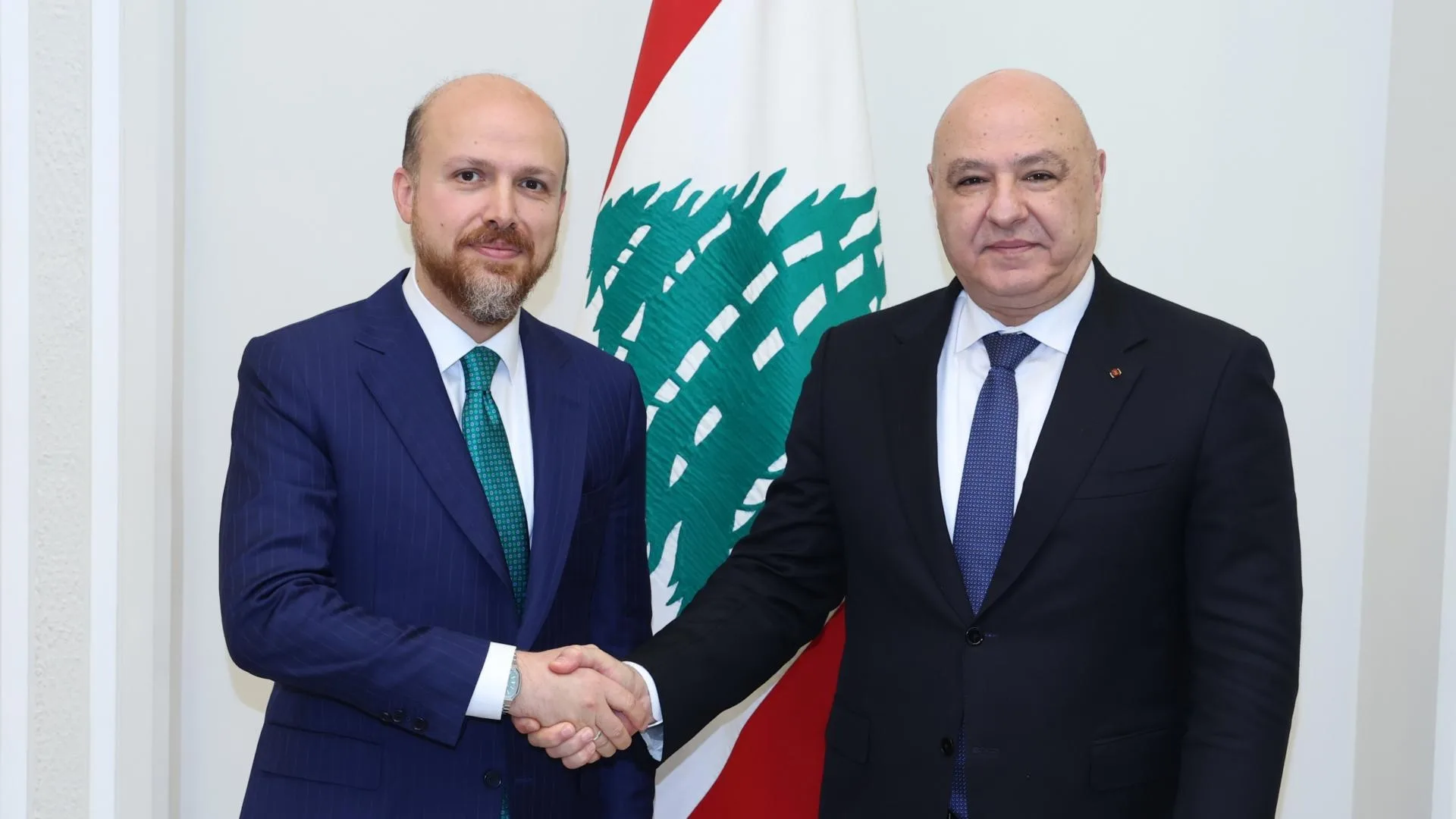
Bilal Erdogan from Baabda: Turkey Supports Extending State Sovereignty Over Its Territories

Kylie Jenner faces fourth lawsuit alleging torture and labor violations

Russia deploys radiation-resistant drones for post-nuclear rescue