·
·


Lebanon
In an unprecedented diplomatic move, Lebanon filed an official complaint with the United Nations against Iran, accusing Tehran of violating the Vienna Convention on Diplomatic Relations, interfering in Lebanese sovereign decision-making, and dragging the country into a devastating war against the will of the state.

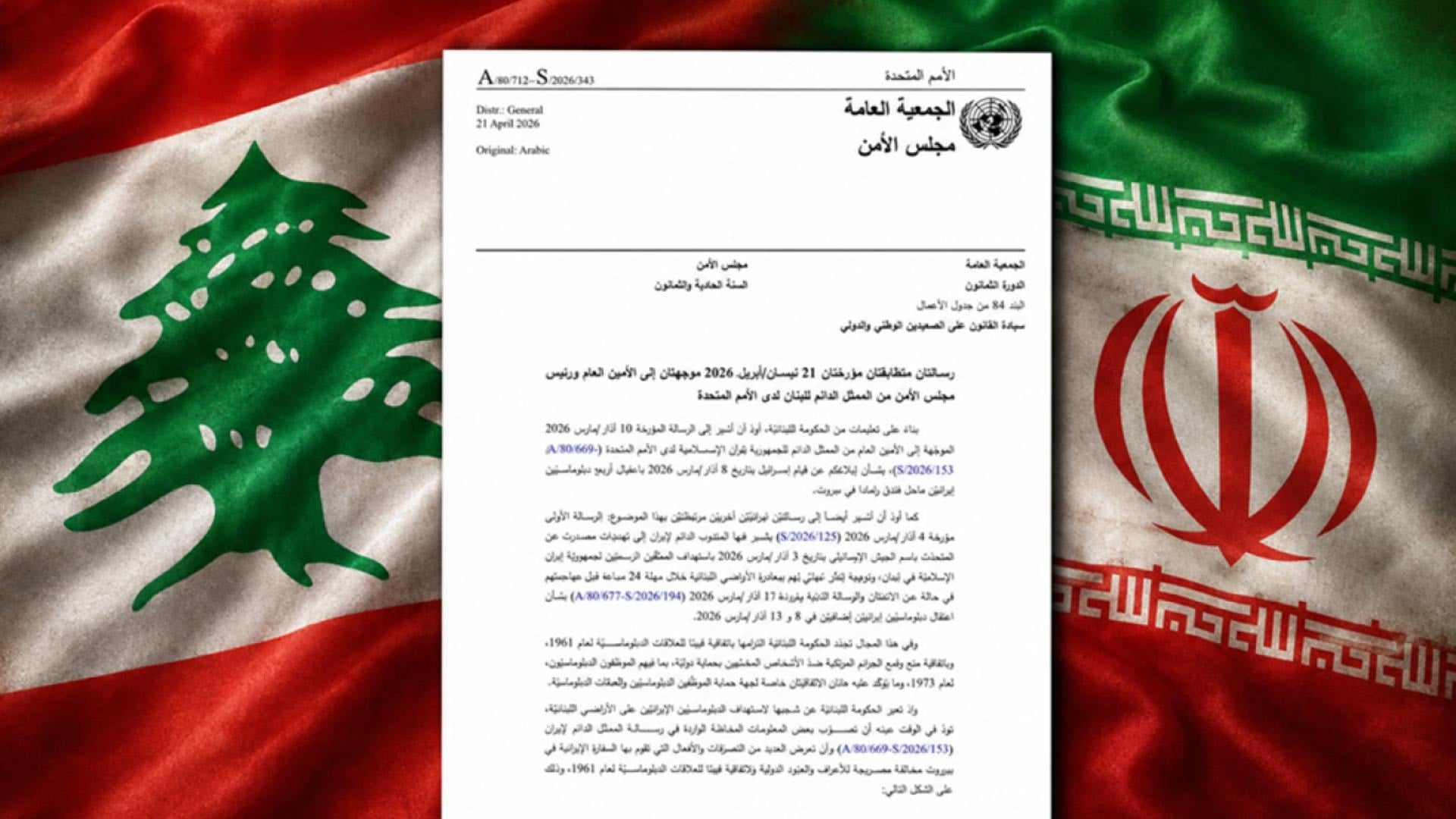
The Lebanese Ministry of Foreign Affairs and Emigrants deposited an official letter addressed to the Secretary-General of the United Nations and to the President of the United Nations Security Council, containing an official complaint from Lebanon against Iran.
In an unprecedented diplomatic precedent, Lebanon filed an official complaint with the United Nations against Iran, in which it accused Tehran of violating the Vienna Convention on Diplomatic Relations, interfering in Lebanese sovereign decision-making, and dragging the country into a devastating war against the will of the state.
The complaint, which became an official document in the Security Council and the General Assembly, challenged the validity of the Iranian narrative regarding the assassination of Iranian diplomats in Beirut, and the Lebanese Ministry of Foreign Affairs denied that the Iranian embassy had coordinated with it regarding their transfer to the "Ramada" hotel, and revealed that some of the dead were not officially registered as diplomats, in violation of the Vienna Convention.
In an unprecedented step in the history of Lebanese-Iranian diplomatic relations, the Lebanese Ministry of Foreign Affairs and Emigrants deposited on April 21, 2026 an official letter addressed to the Secretary-General of the United Nations Antonio Guterres and to the President of the United Nations Security Council, containing an official complaint from Lebanon against Iran, challenging the validity of the Iranian narratives presented before the United Nations, and documenting a number of explicit violations committed by the Tehran embassy in Beirut against the 1961 Vienna Convention on Diplomatic Relations.
The complaint submitted by the Lebanese ambassador to the United Nations Ahmed Arafa, in its content that "Independent Arabia" reviewed exclusively, stipulates "the right of Lebanon to demand acts of international responsibility from Iran and hold it accountable for the consequences of its repeated violation of its international obligations, based on its actions contrary to all international customs and norms, and dragging Lebanon into devastating wars against the will of its constitutional institutions. The Lebanese complaint held Iranian agencies, including the Revolutionary Guard, responsible for carrying out illegal acts, in flagrant defiance of the decisions of the Lebanese government, and for dragging Lebanon into a devastating war that led to the killing and wounding of thousands of Lebanese, the displacement of more than one million citizens, causing incomparable material losses, and Israel's occupation of parts of Lebanese territory and the establishment of security belts.".
Iran and Israel in the Security Council
This complaint against Iran gains double importance in light of the foreign policy pursued by the current Ministry of Foreign Affairs on the one hand, and the broader context of Lebanese diplomacy before the Security Council on the other hand. Since the outbreak of Iran's "support war" on March 2 last year and before that during the Gaza support war in October 2023, Lebanon has not stopped documenting Israeli violations in a series of complaints filed by the Lebanese Ministry of Foreign Affairs against Israel with the Security Council, and the number of complaints in the last four months alone has reached 10.
In addition to the monthly complaints about violations, Lebanon filed a complaint against Israel regarding Israeli attacks on the Red Cross, paramedics, and journalists, and a complaint regarding statements by the Israeli Ministers of Finance and Defense about annexing Lebanon to Israel, and a complaint against the bulldozing operations of southern villages and land confiscation. Consequently, Lebanese diplomacy has become in the position of a complainant on two fronts simultaneously, in an unprecedented precedent, against Israeli violations of sovereignty and land and against Iranian interference in Lebanese sovereign decision-making and dragging the state into a war it did not choose.
What is in the complaint against Iran?
The "complaint letter" has become a document of the General Assembly and Security Council documents and was published on the United Nations documents website under number S/2026/343. It is based on three main axes: correcting the Iranian "falsified" narrative before the United Nations, violating Article 10 of the Vienna Convention, and exploiting diplomatic cover for military action.
In the details obtained exclusively by "Independent Arabia", in the content of the complaint, the Lebanese Ministry of Foreign Affairs denies what was claimed in the letter of the Permanent Representative of Iran to the United Nations Saeed Iravani, which he sent on March 10 last year, about the Iranian embassy informing the ministry in Lebanon of the transfer of four diplomats from their residence to the Ramada Hotel in the capital Beirut shortly before their assassination in an Israeli raid on the seventh of the same month. The Lebanese ministry also denied that the Iranian embassy had coordinated with it in this regard. Based on a memorandum from the Iranian embassy sent to the Ministry of Foreign Affairs and Emigrants on March 16 last year, in which it acknowledged that "the opportunity to contact the Ministry of Foreign Affairs and inform it did not arise," which explicitly contradicts what the Iranian mission to the United Nations in New York reported.
In the text of the complaint, the Iranian embassy also omitted informing the Lebanese Ministry of Foreign Affairs about two individuals among the six diplomats who were killed, namely Ahmad Rasouli and Amir Moradi, contrary to what is explicitly stipulated in Article 10 of the Vienna Convention, which obligates diplomatic missions to inform the host Ministry of Foreign Affairs of the appointment of their members and their status. Consequently, the ministry twice requested the Iranian embassy to provide it with an updated list of the names of the diplomats working for it, without receiving a response until the date of the complaint.
The complaint also addresses what Iranian media published, that the six Iranian diplomats are actually members of the Iranian Revolutionary Guard, and that their pictures were circulated in military uniform with their insignia and ranks. Lebanon considered this a violation of Article 41 of the Vienna Convention, which requires members of diplomatic missions to respect the laws of the host state and refrain from interfering in its internal affairs, as well as a violation of the third paragraph of the same article, which stipulates that the premises of the mission must not be used in any manner incompatible with the functions of the diplomatic mission.
Iranian interference in a war Lebanon did not choose
The Lebanese complaint goes beyond documenting procedural violations by the Iranian side, to paint a comprehensive picture of Iranian interference in Lebanese sovereign decision-making. On March 11 last year, the Iranian Revolutionary Guard announced the execution of the first joint and coordinated attack with "Hezbollah" since the outbreak of the last war, using a mix of missiles and drones to target more than 50 sites inside Israel, the day after the Lebanese government's decision to ban the party's military and security activities.
This interference, according to the Lebanese document, resulted in the killing and wounding of thousands of Lebanese, the displacement of more than one million citizens, the destruction of dozens of villages and towns, in addition to Israel's occupation of parts of Lebanese territory and the establishment of security belts.
Lebanon's complaint against Iran is also based on Tehran's challenge to the Lebanese state's decision to expel the appointed Iranian ambassador Mohammad Reza Raouf Sheibani, declaring him persona non grata, and failing to comply with the request for his departure from Lebanese territory before March 29 last year. The Lebanese Ministry of Foreign Affairs considered that the actions of the Iranian ambassador constitute a clear violation of the provisions of the Vienna Convention, whether by making statements to the media before presenting his credentials, which were considered interference in the management of Lebanon's internal affairs, or by refusing to comply with the decision of the host state and not leaving.
What does Lebanon gain from the complaints submitted to the Security Council?
Beirut does not expect the complaints submitted to the United Nations Security Council to result in binding decisions, whether against Israel or Iran, as the veto rights enjoyed by the permanent member states of the Security Council prevent that. However, the Lebanese bet goes beyond voting to something deeper and more far-reaching.
Former Alternate Representative of the United States of America to the United Nations General Assembly, Ambassador Walid Maalouf, says, "These complaints may not lead to practical results, but they prove the sovereignty of the state in its decision through a political position in which it expresses that it is not afraid of Tel Aviv and Tehran and that it views them equally in terms of holding them responsible for what Lebanon is suffering from." He explains that the complaint against Israel documents violations in permanent UN records that constitute a legal asset that cannot be ignored in any future settlement, in addition to diplomatically embarrassing Israel's allied countries and strengthening the Lebanese negotiating position on the files of withdrawal and demarcation.
In contrast, he considers that the complaint against Iran serves a different but complementary strategic function, as it establishes the Lebanese narrative that "Hezbollah" is a tool in the hands of Tehran, not a Lebanese national movement, and embodies a clear sovereign message distinguishing Lebanon from the "axis of resistance" and opens the door for Western and Gulf support for reconstruction and disarmament.
He adds, "More importantly, these two complaints pave the way for Lebanon to pursue an international legal path to demand both Israel and Iran full compensation for all damages inflicted on the land and people. Israel is responsible for the direct field destruction that affected villages, infrastructure, and killed civilians, and Iran is consequently responsible for financing and igniting the war through its armed 'proxy.' Documenting this dual responsibility before the United Nations is the necessary first step for any serious compensation path. Thus, the two complaints complement each other in one coherent strategy: documenting external aggression on the one hand, and exposing Iranian guardianship on the other hand, in a Lebanese endeavor to regain control of national decision-making and reclaim the right of the Lebanese people to fair compensation for the devastation that befell them."
Losses greater than the Lebanese state can bear
In contrast, Maalouf confirms that Lebanon's human and material losses resulting from the support wars and confrontations between Israel and "Hezbollah" are greater than the Lebanese state can bear, and the complaints against Israel and Iran may help Lebanon demand that they pay compensation.
The complaint to the Security Council is not necessarily to win a vote, but rather, in its essence, a diplomatic tool to build the Lebanese narrative before the world, document the legal position, and politically embarrass the aggressor parties even in the absence of any binding decision. There is no doubt that Lebanon directing an official complaint against Iran to the United Nations constitutes an exceptional diplomatic event whose impact goes beyond merely documenting violations.
Here, Maalouf believes that on the legal level, this procedure establishes an official UN record that can be relied upon in the future in any international arbitration or legal path, and opens the door to activating the provisions of state responsibility in customary international law and what was stipulated in the draft of the International Law Commission of 2001. On the political level, this complaint sends a clear message to Tehran that the new Lebanon is no longer prepared to accept the logic of guardianship or overlook violations in the name of strategic partnership, and it also enhances the credibility of the Lebanese government internationally in its efforts to restore full sovereignty over its security decision and its land.
Deniz Rahme Fakhry
independentarabia