·
·


Tech & Science
A new preprint examines where Dyson swarms may be easiest to spot, focusing on red dwarfs, white dwarfs and unusual infrared signals.

Red dwarfs and white dwarfs may be the best places to look for Dyson swarms, according to a new preprint on arXiv by Amirnezam Amiri of the University of Arkansas.
The paper says astronomers may be able to identify possible Dyson swarms by searching for unusually cold, clean infrared signals around long-lived stars. Since physicist Freeman Dyson introduced the idea in 1960, the “Dyson sphere” has become one of the most sought-after possible technosignatures in the search for advanced alien civilizations.
Amiri examines what such a structure would look like from Earth and identifies the kinds of stars where the search may be most worthwhile. The basic idea is that a civilization far beyond our own could surround its star with a “sphere” or, in more modern terms, a “swarm” of smaller components designed to capture nearly all of the star’s energy.
One promising target is the red dwarf. These stars are the most common in the Milky Way and use their nuclear fuel very slowly, so some are expected to survive for trillions of years, much longer than the current age of the universe. Because they are much smaller than the Sun, a Dyson swarm could be placed about 0.05 to 0.3 AU from the star’s surface.
White dwarfs may be even more attractive from an engineering standpoint. They are the dense, cooled remains of stars like the Sun, compressed to tiny sizes with radii about 1% of their original star. Around a white dwarf, a Dyson swarm could orbit only a few million kilometers from the surface, and white dwarfs can also emit energy steadily for billions of years.
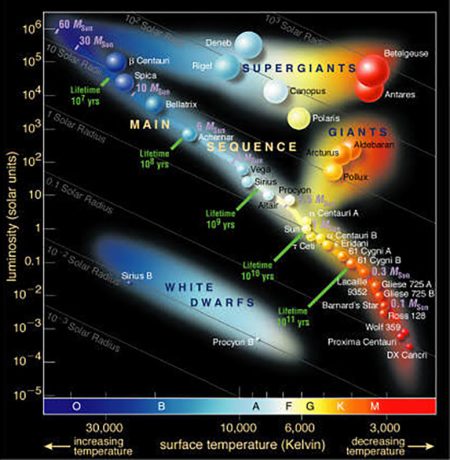
Astronomers usually classify stars with the Hertzsprung-Russell, or H-R, diagram, which is based on temperature and luminosity. A Dyson sphere would block all of a star’s natural light and shift it to the right on that diagram, where lower temperatures are mapped.
Energy can neither be created nor destroyed, so the sphere would have to emit the same amount of radiation as the star puts into it. It would do that as heat, or infrared light, while the luminosity itself would not change at all. Since H-R diagrams use bolometric luminosity, the object would appear in the same vertical place as its host star, whether that is a red dwarf or a white dwarf.
A typical red dwarf sits in the lower right-hand corner of an H-R diagram with a surface temperature of around 3000K degrees. A Dyson sphere surrounding a star would have a temperature down to 50K, two orders of magnitude lower, and there are no natural stars in that area.
Another clue would be a lack of dust. A star without a Dyson sphere would typically show a spectral line for silicate emission that is commonly associated with dusky disks, but radiator panels would look remarkably “clean” to a spectrograph monitoring them.
In the “swarm” version, there would likely be gaps between some of the solar collectors, or varying thickness in certain parts of the swarm. The paper says this is intended to make the material requirements physically possible, since modern calculations show that an actual full Dyson sphere is physically impossible even with relatively small radii.
If there were small gaps, the star would behave exceedingly erratically, with non-natural light curves as the structure rotates. Since infrared is the specialty of the James Webb Space Telescope, it is well placed to monitor for these kinds of structures, and older telescopes like WISE are also being actively used.
In May 2024, a paper highlighting work from Project Hephaistos identified seven strong Dyson sphere candidates, all red dwarfs, out of a catalog of 5 million stars. One was eliminated as a possible source because there was a supermassive black hole aligned perfectly in the background around the star, explaining the anomalous readings.
That still leaves five more potential candidates worth closer observation. The new paper adds another tool to astronomers’ understanding of what to search for to one day find one of these elusive technosignatures.