·
·


Tech & Science
Japanese scientists have developed lightweight electronic units enabling remote control of cyborg cockroaches for use in search, rescue, and hazardous environment exploration.

Researchers in Japan have made significant progress in integrating live insects with miniature electronic systems, including electrodes, sensors, and control units, allowing for remote guidance of their movements while preserving their natural mobility.
This integration aims to leverage the insect's efficiency in navigating confined and rugged spaces, employing them in tasks that conventional robots find challenging, such as search and rescue, infrastructure inspection, and exploration of hazardous environments. Ongoing research seeks to expand their applications in the future.
A recent experiment by Japanese scientists successfully equipped cockroaches with miniature electronic modules, termed "backpacks," which contain solar cells and control components, enabling remote direction of their movement.
Kingiro Fukuda and his team at the RIKEN Institute's Laboratory for Integrated Device Technology developed an ultra-light electronic unit based on flexible solar cells with a thickness not exceeding 4 microns, accompanied by a small rechargeable battery. This unit supplies the power necessary to operate control systems and transmit signals, and its design allows attachment to the cockroach's back without hindering its movement or reducing its efficiency during locomotion.
This advancement builds upon earlier research conducted at Nanyang Technological University in Singapore, which aimed to develop cyborg insects capable of efficiently accessing hazardous or confined environments beyond the reach of small robots.
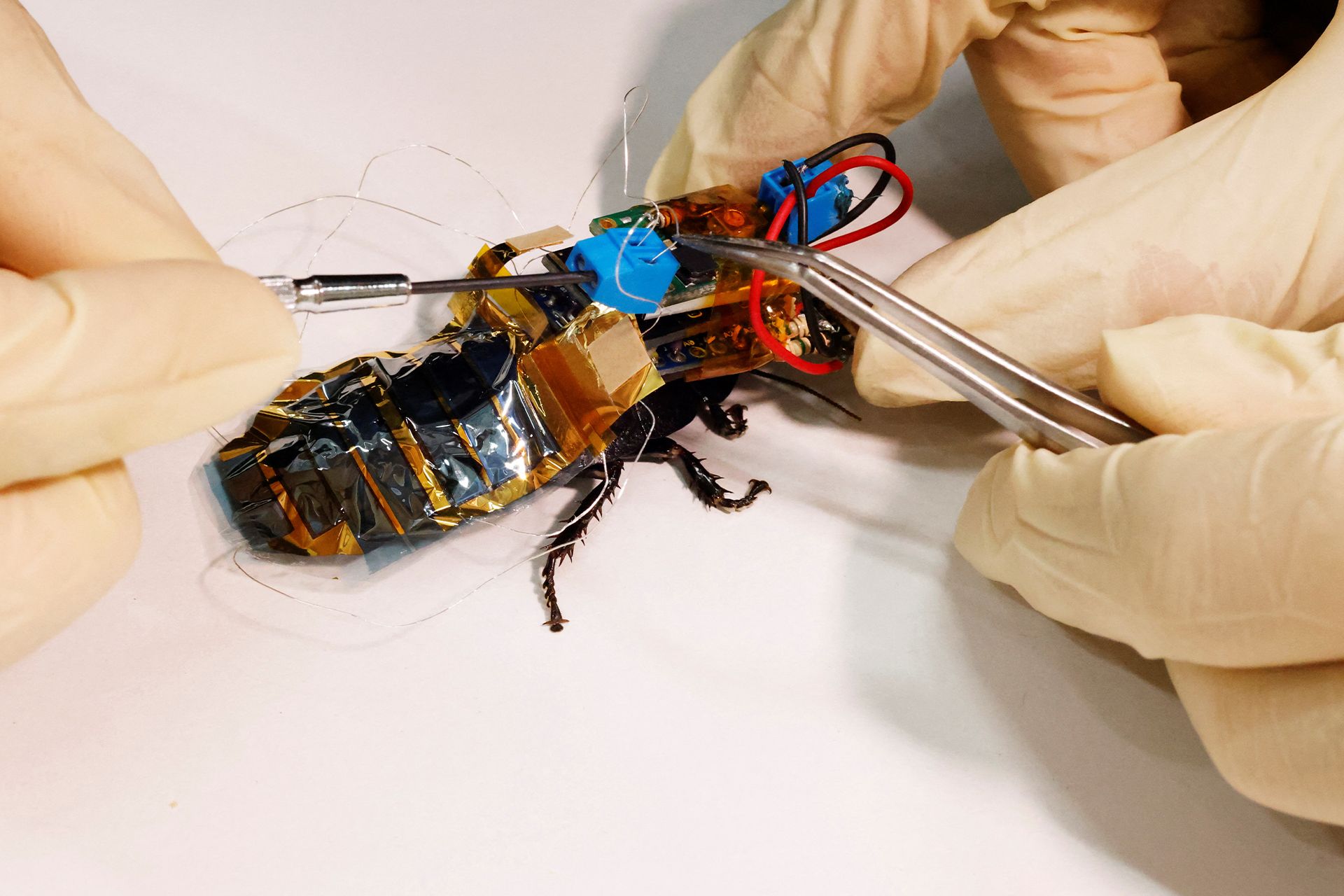
Fukuda explained that one of the main advantages of cyborg cockroaches is their reliance on their natural muscles for movement, which limits energy consumption to the control systems alone. This contrasts with miniature robots that quickly deplete their batteries, thereby granting the modified insects longer operational times for exploration, search, and rescue missions.
Cyborg cockroaches combine the living insect's body with precise electronic components that enable remote steering and control of their motion while maintaining their inherent ability to move naturally.
The Madagascar hissing cockroach is the most commonly used species in cyborg cockroach research due to its biological characteristics, making it a suitable platform for integrating electronic systems with living organisms, thus preferred by researchers in this field.
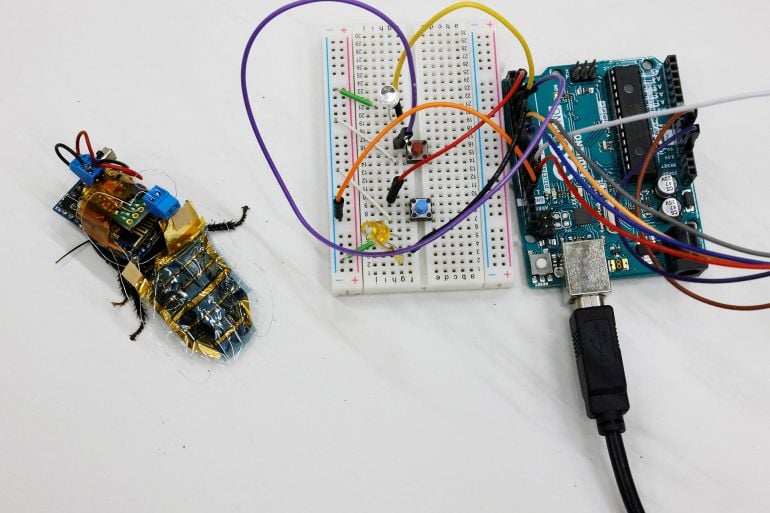
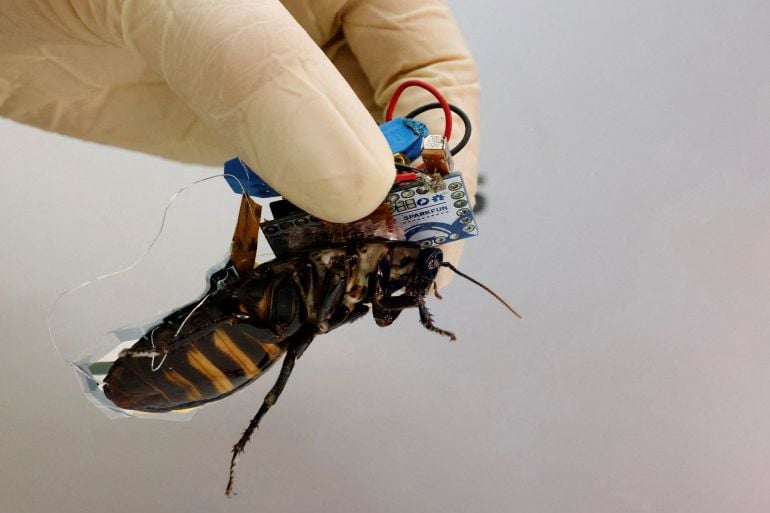
This species is relatively large, measuring between 7 and 10 centimeters in length, providing sufficient space for mounting electronic components and sensors. Its robust structure allows it to carry these devices and move through rough terrains.
Additionally, the absence of wings facilitates the attachment of the electronic control unit, or "backpack," without impeding the cockroach's natural movement or affecting its performance during tasks.
Moreover, the species can live up to five years and quickly recover its normal posture if flipped onto its back, features that enhance its reliability and suitability for long-term missions such as search and exploration in areas inaccessible to traditional robots.
Research on cyborg cockroaches has seen notable progress with the invention of a miniature diving suit developed by a team led by Professor Hirotaka Sato. This suit enables the insect to operate in submerged or low-oxygen environments.
Produced using three-dimensional printing technology, the suit incorporates a system that chemically generates oxygen. Hydrogen peroxide is injected to react with manganese dioxide, producing oxygen that is directed straight to the insect's respiratory openings, allowing it to continue breathing underwater.
This technology enables cyborg cockroaches to survive and move underwater or in low-oxygen settings for up to three hours at depths reaching approximately 50 centimeters, thereby broadening their potential use in hard-to-reach environments.
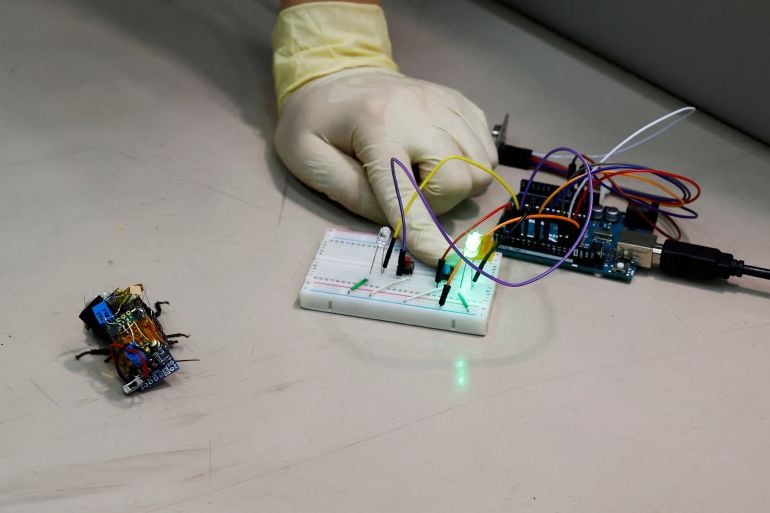
Research is focusing on deploying cyborg cockroaches across a variety of tasks, utilizing their ability to navigate narrow spaces while carrying small sensors.
In search and rescue operations, they can be sent into disaster sites such as collapsed buildings after earthquakes or flood-affected areas to maneuver through rubble and narrow cracks. Equipped with infrared cameras and sensors, they assist in detecting survivors and collecting data from locations inaccessible to rescue teams or conventional robots.
They are also expected to play a significant role in infrastructure inspection by examining pipes, tunnels, and confined spaces to identify corrosion or leaks, thus accelerating maintenance processes and reducing risks.
Looking ahead, researchers aim to apply this technology in space exploration by developing cyborg cockroaches capable of carrying small sensors to explore rough terrains on planetary surfaces like Mars, gathering data from areas unreachable by traditional robotic vehicles.