

Tech & Science
Musango matusadonaensis reveals distinct Zimbabwean dinosaur lineage
Newly named Musango matusadonaensis indicates Zimbabwe hosted a unique Triassic dinosaur community, challenging assumptions about South African faunal extension.

The discovery of Musango matusadonaensis demonstrates that ancient Zimbabwe supported a prehistoric ecosystem fundamentally different from the well-documented dinosaur populations of neighboring South Africa. This newly identified sauropodomorph challenges previous scientific expectations that fossil beds in the region would yield familiar species common to southern African sites.
Unique Triassic fauna emerges
Africa contains up to 25% of Earth’s animal and plant diversity, driven by varied habitats ranging from deserts and grasslands to forests and coastlines. These deep evolutionary roots have attracted paleontologists for nearly two centuries, though the continent is often highlighted primarily for hominid fossils revealing human ancestry. Beyond these finds, Africa hosts significant deposits of extinct animals, including dinosaurs.
Scientific recognition of African dinosaurs began in the 1850s with specimens from the Eastern Cape in South Africa. Since then, rich fossil beds have been documented in Lesotho, Tanzania, Egypt, Niger, Malawi, Madagascar, and Morocco. Zimbabwe has contributed to this map since 1916, yet its specific role in early dinosaur evolution remained underexplored until recent excavations.
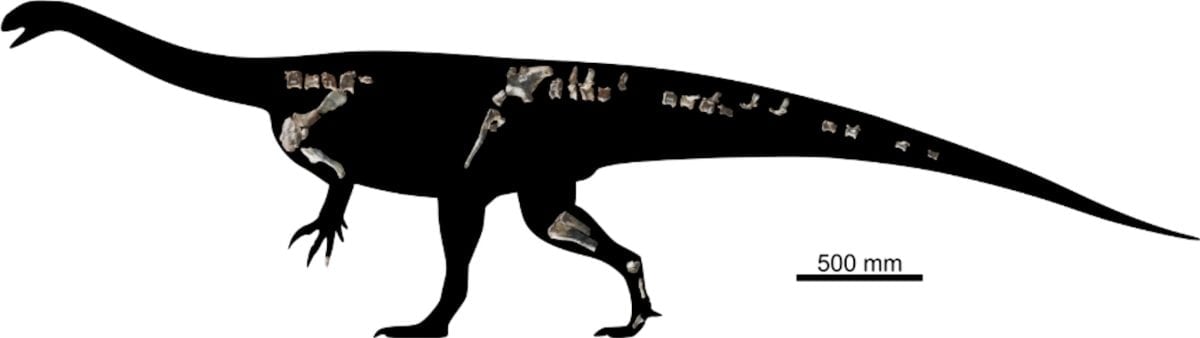
Skeletal Reconstruction Reconstruction of Musango
Anatomy of Musango matusadonaensis
Musango matusadonaensis, described as a bipedal sauropodomorph, represents a new addition to the Triassic record. Sauropodomorphs are the subgroup that eventually evolved into four-legged, long-necked giants such as Diplodocus. The incomplete skeleton was recovered from the bank of the Nyamasango River near Musango Island, a location reflected in its scientific name.
Analysis of the anatomy indicates the animal walked on hind legs, measured approximately 4.5 meters in length, and weighed 220 kg. Growth marks within the bones suggest it was a subadult at the time of death. While the skull was not preserved, preventing direct dietary analysis, close relatives were largely herbivorous.
Reviving historical research efforts
Early fossil discoveries in Zimbabwe received limited attention from the broader scientific community until the 1970s. Pioneering work by Geoffrey Bond and Michael Raath uncovered abundant material in the hinterlands of Bulawayo and the lower Zambezi Valley, which forms the border with Zambia. At that time, most findings were classified as known species originating from neighboring South Africa.
Research momentum stalled for several decades until local safari camp manager Steve Edwards identified productive new sites along the shore of Lake Kariba, an artificial lake forming much of the Zimbabwe-Zambia border. News of these discoveries reached Jonah Choiniere at the University of the Witwatersrand in Johannesburg. An expert on early dinosaurs, Choiniere recognized the significance of the material and assembled an international team comprising South African, Zimbabwean, and UK-based collaborators.
Expeditions conducted in 2017 and 2018 faced logistical challenges because the sites lie deep within Matusadona National Park. The team utilized a houseboat on Lake Kariba as a mobile hotel and laboratory to prospect the shoreline. Cleaning and studying the collected material has continued since those trips.
Distinct evolutionary paths
The expeditions yielded a trove of fossils extracted from brick-red mudstones and sandstones deposited by ancient rivers around 210 million years ago during the Late Triassic period (237-201 million years ago). Geological evidence and plant fossils indicate the landscape was dry, dotted with large conifer trees, and featured green corridors of vegetation along permanent watercourses.
Sauropodomorphs dominate the Late Triassic dinosaur record. However, Musango and its relative Musankwa, described from the same beds in 2024, appear unique to Zimbabwe. Despite similar ages and geographic proximity to South African sites, all material collected so far reveals animals distinct from those found elsewhere. These Zimbabwean dinosaurs are not even the closest relatives of their South African counterparts.
Additional fossil finds include lungfish and phytosaurs, aquatic reptiles that are rare or absent in South African sites. Reappraisal of historical collections from Bulawayo suggests many of those fossils also cannot be referred to South African species, contradicting earlier assumptions.
Climatic factors behind divergence
Zimbabwe lies further north than South Africa and closer to the equator, suggesting climatic differences may explain the distinct faunal compositions. Climate strongly influences the distribution of living animals, and researchers suspect environmental conditions drove the separation of these prehistoric communities. To investigate this hypothesis, the team plans to return to Kariba for further fossil searches.
Future work will focus on collecting more data regarding the exact ages and environments of the dinosaur-bearing rocks to allow precise comparisons with other sites. As the significance of these dinosaurs comes to light, Zimbabwe is increasingly contributing to understanding early dinosaur evolution.
Latest news

White House Spokesperson Karoline Leavitt Admits: I Failed the Bar Exam

US Weighs Returning Sanctioned Tankers to Global Trade

Carney warns US seeks to dismantle Canada as Alberta votes
