·
·


Tech & Science
SpaceX’s Starship Flight 12 ended with the booster breaking apart in the Gulf after a controlled splashdown attempt failed.

SpaceX’s latest Starship test flight ended with the Super Heavy booster tumbling and breaking apart after a splashdown attempt in the Gulf failed.
The Flight 12 mission was the first Starship launch since October and introduced the V3 design, which uses upgraded Raptor engines for easier maintenance and faster reuse. It also marked the first full test flight for the rocket.
The 407-foot megarocket lifted off from Texas with 33 Super Heavy booster engines and six engines on the upper stage, making it the most powerful rocket ever launched. One engine did not ignite at liftoff, but the rocket still climbed and completed stage separation high above the Gulf.
SpaceX sent the vehicle up on May 22 from a newly completed second launch pad at its Starbase facility in South Texas. Liftoff came at 6:30 p.m. EDT (2230 GMT), and the 408-foot-tall rocket began its 12th suborbital test flight.
After separation, the Super Heavy booster tried to return for a controlled splashdown in the Gulf. The engines required for the landing burn did not relight properly, and the booster broke apart after hitting the sea.
“Following stage separation, the Super Heavy booster performed a directional flip maneuver and attempted its boostback burn. It was unable to light all planned engines and performed a partial boostback burn that ended early. Super Heavy attempted to reignite its engines for the landing burn before experiencing a hard splashdown in the Gulf of America,” said a statement from SpaceX.
The upper-stage Starship kept going and completed several test objectives, including the deployment of 20 dummy Starlink satellites and two operational satellites fitted with cameras to capture heat shield footage during re-entry. One of the ship’s six Raptor engines shut down during ascent, but the other five carried it to nearly 121 miles (195 kilometers).
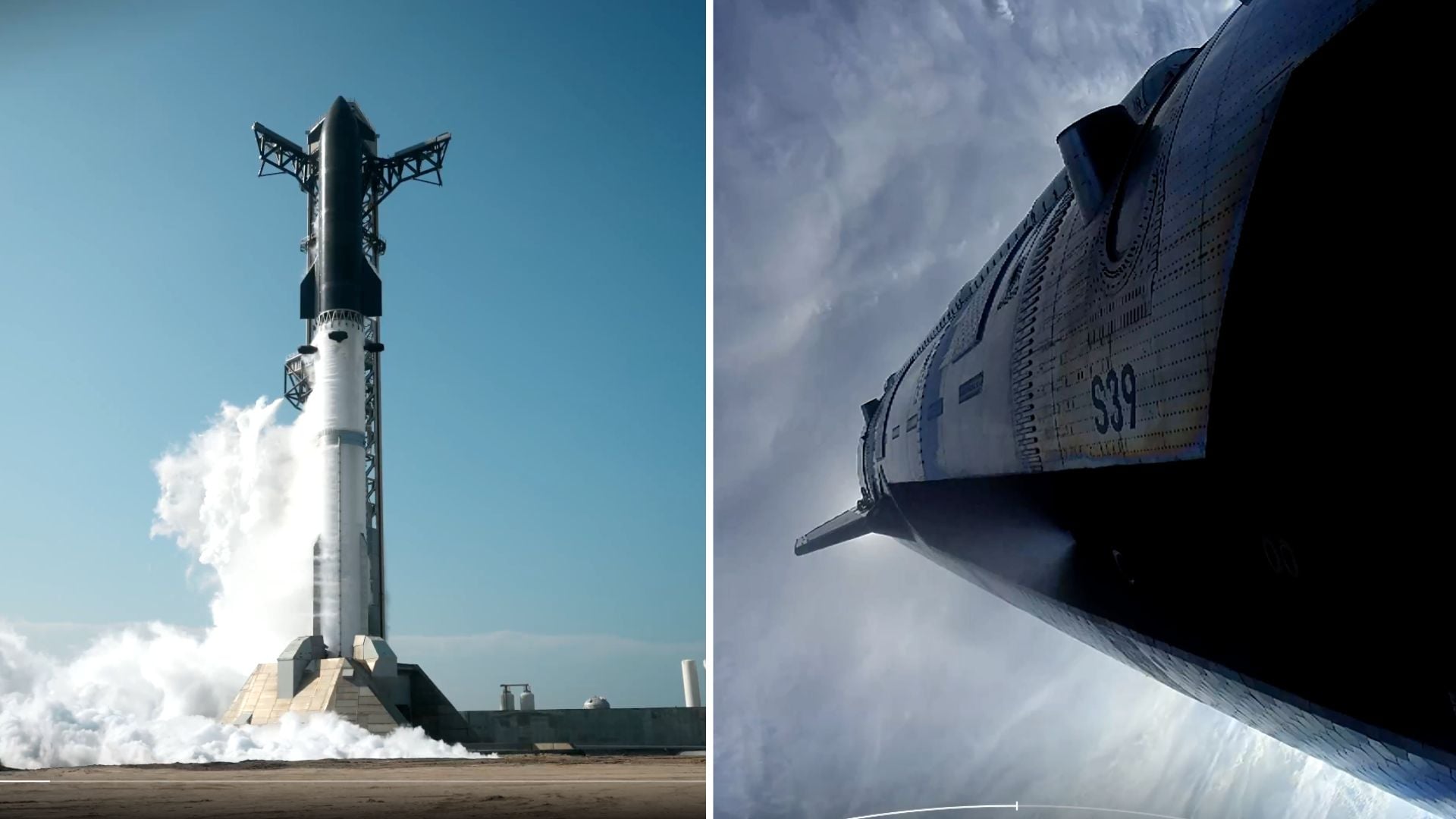
About 2 minutes and 20 seconds into flight, hot staging took place, with Ship igniting its engines before separation from Super Heavy. Starship V3 does not use a jettisoned interstage ring; instead, it has a fixed structure around the booster’s top to support engine ignition and separation dynamics, reports Space.com.
SpaceX engineers also tested a new launch pad configuration at Starbase during the Flight 12 mission. The pad stayed stable during liftoff, which SpaceX said validated it for future operations, and the mission lasted about one hour from launch to splashdown.
A minor hydraulic fault on the tower arm had delayed the attempt the previous day. Earlier, the launch was scrubbed at T-40 seconds because of a hydraulic pin failure and ground system issues, delaying the first test flight.
After separation, Super Heavy attempted a boostback burn toward Starbase but did not complete the maneuver. SpaceX had planned a Gulf of Mexico splashdown instead of tower recovery to avoid pad risk on the first flight of new hardware, and the booster ultimately fell into the Gulf.
Earlier V3 testing in November resulted in the loss of a Super Heavy booster intended for this mission, contributing to a gap of more than six months since the previous Starship launch. The spacecraft later re-entered Earth’s atmosphere over the Indian Ocean, completed a controlled descent, landed in the targeted splashdown zone and exploded on contact with the water, as planned for the test mission.
NASA is banking on Starship as a crewed lunar lander for its Artemis program. The agency is also working with Blue Origin, which is developing the Blue Origin lunar lander, while Artemis 2 has already completed a crewed lunar flyby mission. NASA is targeting Artemis 3 for mid to late 2027 and Artemis 4 for a lunar landing in 2028.