·
·


World
Recent polling reveals Gadi Eisenkot's party leading ahead of Netanyahu's Likud, with Naftali Bennett's party losing ground before upcoming Israeli elections.

A recent opinion poll has indicated significant shifts in Israel's political landscape, potentially prompting Prime Minister Benjamin Netanyahu to reconsider his strategies ahead of forthcoming elections.
Channel 13 reported on Wednesday evening that the newly established party "Yeshar," led by former General Gadi Eisenkot, has overtaken Netanyahu's Likud party for the first time since Yeshar's emergence.
The Hebrew-language channel noted that if elections were held today, Eisenkot's Yeshar would become the largest party in Israel, securing 23 seats, an increase of three seats compared to the previous poll.
Likud would come in second with 22 seats, while Naftali Bennett's Yichud party lost two seats—after regaining strength in the prior poll—placing third with 15 seats.
The poll also showed that the Democratic party led by Yair Golan and Israel Beiteinu headed by Avigdor Lieberman each received 10 seats. Following them, the parties Shas, Yahadut HaTorah, and Otzma Yehudit each obtained 8 seats.
The Arab Change Front alliance earned 6 seats, whereas the United Arab List and the Religious Zionism party each secured 5 seats.
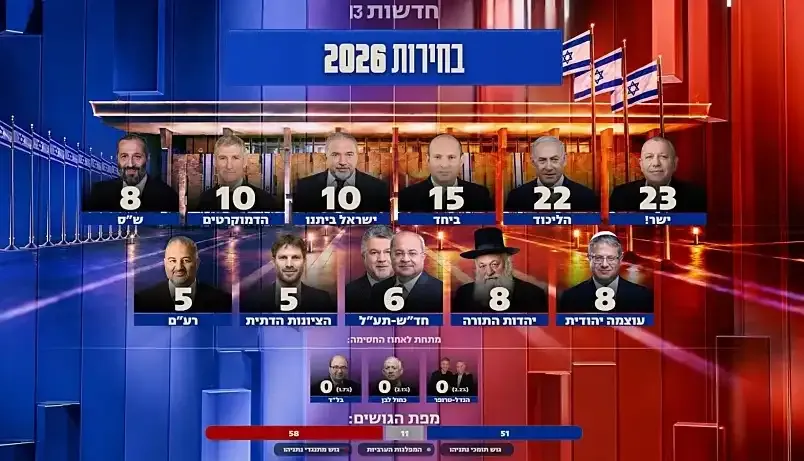
Parties failing to cross the electoral threshold included the Joint List led by Cheli Trooper and Yoaz Hendel with 2.2%, Blue and White led by Benny Gantz with 2.1%, and the National Democratic Assembly with 1.7%.
The bloc opposing Netanyahu holds 58 seats, while Netanyahu's bloc has 51 seats, with Arab parties occupying 11 seats in between. This results in a total of 69 opposition seats compared to 51 for the current coalition.
Regarding suitability for the prime minister position, Eisenkot also leads Netanyahu; 46% of respondents considered Eisenkot the most suitable candidate, compared to 36% for Netanyahu, while 18% answered "I don't know."
Channel 13 presented potential coalition scenarios based on the parties' polling results, concluding that Netanyahu's coalition would decrease to 49 seats, while the opposition bloc would remain steady at 58 seats, with Arab parties maintaining 14 seats.