

World
Million-Strong Protest in Italy Against Meloni's Budget and Cost of Living
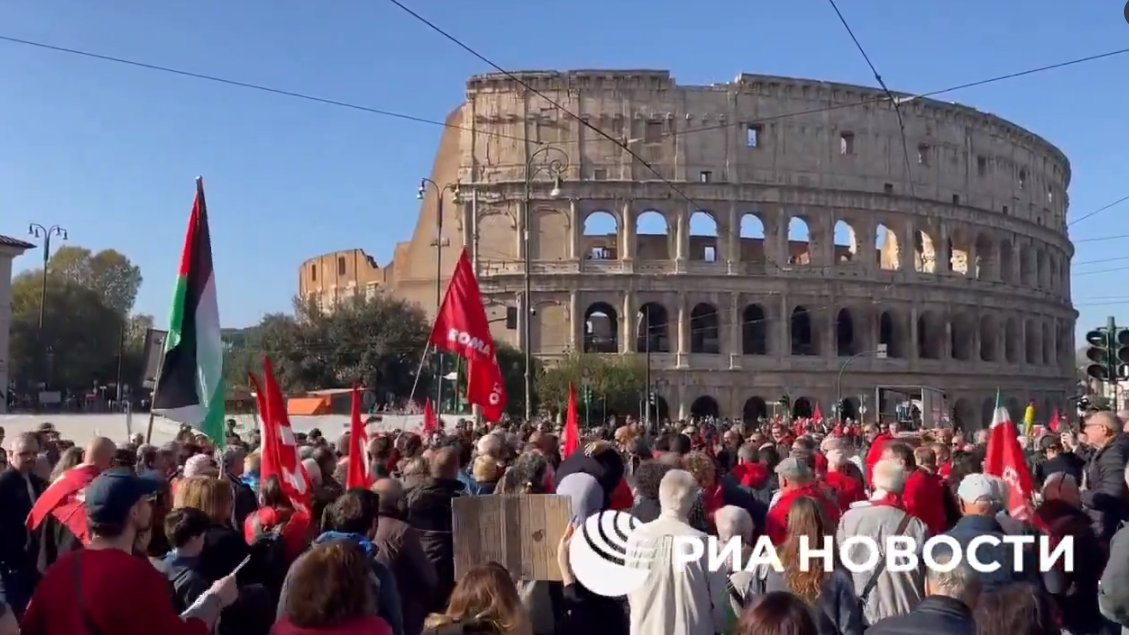
Hundreds of thousands of Italians took to the streets in over 100 cities on Friday, protesting Prime Minister Giorgia Meloni's 2027 budget draft, rising living costs, and increased military spending.
Hundreds of thousands of Italians took to the streets in a wave of widespread protests on Friday, extending to more than 100 cities, in a new escalation of pressure on Georgia Meloni's government, amid objections to the 2027 budget draft, rising cost of living, declining public services, and increased military spending.
The Italian General Confederation of Labour (CGIL), the country's largest trade union, estimated the number of participants at approximately 1.5 million people, while its Secretary-General Maurizio Landini said the strike recorded an average participation rate of 60 percent, according to union figures. The mobilization came under the slogan "The Future Now," with the participation of workers, students, and retirees, on a day that also saw movements by independent unions and student gatherings coinciding with youth protests in more than 25 European countries.
According to the Italian newspaper "Avvenire," demands focused on improving wages and pensions, providing stable jobs, combating inflation and high cost of living, as well as protecting education and public health and facilitating access to housing. Objections to rearmament were also prominent; students raised slogans demanding that funds be directed to schools and universities instead of military spending.
Budget at the Heart of the Confrontation
The 2027 budget bill formed a major axis of the protests, as unions accuse Meloni's government of distributing the burdens of economic conditions onto workers, retirees, and youth, while allocating resources that do not meet the needs of public services.
Landini, during his participation in the Rome march, said the government is required to reconsider the budget, criticizing the ruling majority's need to submit nearly two thousand amendments to their draft, which he considered evidence of confusion within the coalition regarding the formula they presented.
These criticisms intersect with concerns about the erosion of household purchasing power, the difficulty for young people to obtain housing, and the pressures facing schools and hospitals. "Avvenire" reported complaints from protest participants about the decline of the middle class, rising fuel prices, and long waiting times in emergency departments.
Students Expand the Front
Student presence was one of the most prominent features of the movement; university and school groups joined marches in many cities, demanding increased funding for public education, improved study conditions, and addressing the student housing crisis.
In Rome, student groups participated in marches separate from the union's action, while other cities saw an overlap between labor and student marches. The French newspaper "Le Monde" noted that students led several gatherings, quoting Federica Curioni, national coordinator of the Italian Student Union, who criticized the deterioration of educational institutions' conditions and the difficulty of finding housing, as well as her objection to caps on the number of foreign students in classrooms.
Objections extended beyond the educational aspect to the government's defense policy. In Turin, protesters raised banners criticizing the ministers of defense and universities, writing "University of War," indicating their rejection of linking educational institutions with rearmament priorities.
Field Clashes and Tensions
The protests were not without tension, as the Italian network "Sky TG24" reported clashes in Turin, Bologna, and Rome, where police used water cannons and carried out operations to disperse protesters in Turin, while clashes occurred between police and protesters near the headquarters of the Industrialists' Association in Bologna.
In the capital, some students threw bottles, firecrackers, and other objects toward the Ministry of Education, while Genoa saw the occupation of a university building, and a highway near Padua was closed for about two hours before reopening.
"Avvenire" reported injuries to seven police officers, six of them in Rome and one in Venice. In a scene reflecting division within the student movement regarding protest methods, two students sat alongside police officers in the capital, declaring their rejection of violence.
Opposition and Union Division
The demonstrations gained a political dimension with the participation of prominent opposition figures in the Rome march, including Elly Schlein, leader of the Democratic Party, Giuseppe Conte, head of the Five Star Movement, and Angelo Bonelli from the Green and Left Alliance, at a time when opposition forces are trying to expand their presence in social and economic files, benefiting from union and student objections to government priorities.
However, the protest scene was not entirely unified, as unions such as "Cobas" organized independent actions, while student groups took positions criticizing some traditional unions themselves, considering that they do not adequately represent the demands of workers and youth. Additionally, the unions "Sisal" and "Uil" chose protest paths separate from the general strike called by "CGIL."
Mobilization Likely to Continue
According to statements by Landini reported by Italian media, the union does not intend to end its actions here, announcing two new protest stations on December 5 and 12, the first focusing on defending public health, while the second addresses the situation in southern Italy.
These developments place Meloni's government before a test that goes beyond the strike day itself: the extent of its ability to contain objections related to wages and public services, and to convince broad segments of society that government spending priorities respond to their needs.
While the participant numbers announced by the union, which "Le Monde" could not independently verify, do not necessarily imply a unified political stance against the government, the widening participation and overlapping labor and student demands reveal a multi-party social front beginning to pressure the ruling coalition's economic and financial choices.
Latest news
After Grueling Talks, World Moves Closer to Curbing 'Killer Robots'
Mass Mobilization and Deadly Strike: Israel Moves to Form Military Alliance Against Iran
Tripoli Fishermen Protest Port Minicity Fees, Demand Freeze
