Lebanon
Roumieh Prison Strike Enters Fifth Day; Lebanese Inmates Send Message: Why Expel Syrians and Leave Us Behind?
The ongoing hunger strike at Lebanon's Roumieh Central Prison enters its fifth day, with over 400 inmates in Block B refusing food and medication. In a powerful open letter, Lebanese prisoners question why they are punished for being Lebanese while Syrian detainees are released, highlighting systemic injustice and neglect.

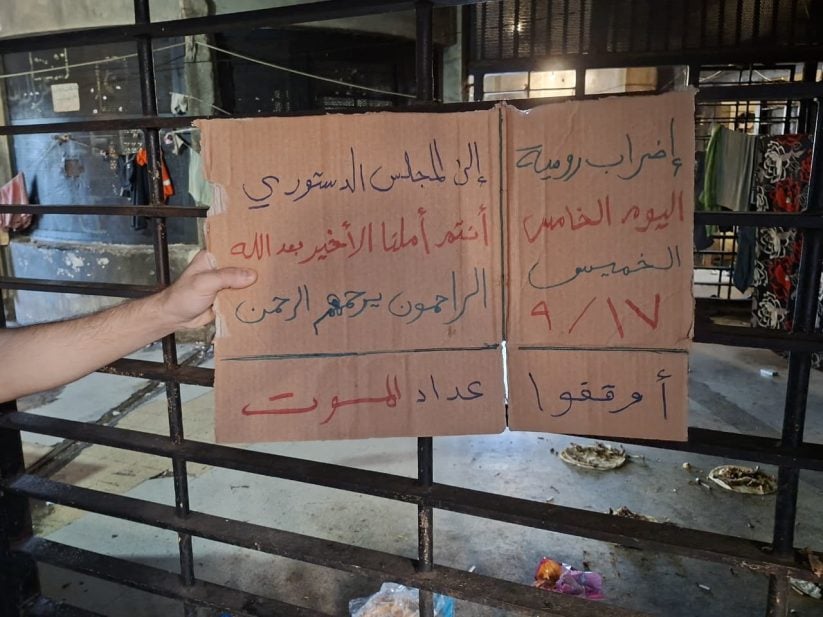
The comprehensive strike initiated by inmates at Lebanon’s Roumieh Central Prison enters its fifth consecutive day, as more than 400 prisoners in Building "B" continue to refuse food and medicine in protest against the suspension of the general amnesty law and the reduction of exceptional penalties, pending a decision from Lebanon’s Constitutional Council following its recent suspension after a legal challenge filed by MP Gebran Bassil and members of his parliamentary bloc.
In an update on humanitarian conditions inside the prison, a spokesperson for the inmates said signs of severe exhaustion have begun to appear among several detainees, particularly the elderly, with multiple cases of fatigue reported— one inmate was urgently transferred to hospital at 1 a.m. due to a sudden deterioration in health and dangerously low blood sugar levels. However, the inmates’ morale remains high and their determination to continue the strike is unwavering, according to the statement.
Continuing humanitarian appeals, an emotional open letter reached the phones of several journalists today from a group of Lebanese inmates, who wrote:
"We are a group of Lebanese inmates from various sects across several prisons. We address this message to the Constitutional Council, our leaders, our political parties, our media, and all Lebanese citizens.
Why do you punish us simply for being Lebanese? Why do you release Syrian prisoners back to their homeland before our very eyes, while leaving us trapped in human stables where we die one after another?
Syrian prisoners are visited and inquired about by their embassy. We have no embassy to inquire about us. We are not against our Syrian brothers in prison—the principles of justice and fairness belong to every human being. But where was Gebran Bassil when Syrian prisoners were returning home honored and respected? Or are we merely the 'empty wall' onto which he can vent his hatred, and the only political currency he can trade on during elections?
To the esteemed Constitutional Council: Why do you allow political parties to turn you into a battleground? Why do you permit them to settle their scores through you? Why do you let Bassil transform your national institution—meant to embrace all Lebanese—into a tool to break us and destroy what little hope we still have in this country?
To our Lebanese media: Since the amnesty was enacted, five inmates have died— one Syrian and the rest Lebanese. Did you notice that the death of the Syrian inmate filled news broadcasts and Syrian media platforms, becoming a case demanding the highest level of attention? Meanwhile, the deaths of your four Lebanese sons were reduced to fleeting news, circulated in despair by a few family pages. Has our death become mere routine information, too insignificant to qualify as news? Do we ask the Syrian media to carry our burden because we are parasitic creatures and superfluous pests in this land?
Have we been destined to die silently in our own country’s prisons, since medicine, food, and judicial fairness have become mere illusions we wait for but never receive?
Have we become strangers and foreigners in our own homeland? Is this truly how far you’ve gone? We are exhausted, our families are broken and scattered. If any of you spent just one day in these graves and experienced even a fraction of what we endure, you would know we live in the depths of hell.
Send us to the deserts. Cast us into the seas. Send us to any remote corner of the earth and be rid of us. Free us from the death and suffering we endure at the hands of blood merchants and politicians who grant amnesty to themselves and their allies while denying it to others.
We are not all criminals, offenders, or villains. Most of us have remained untried for years. Most cannot afford to support themselves, and their families cannot afford to support them. Most cannot bear the exorbitant costs of lawyers, medical treatment, or medicine. Most now see their country treating others like a loving mother, yet treating them like the unwanted son.
When the amnesty came, we felt Lebanon finally turned toward us, recognized us as human beings, and welcomed us back into its embrace. Then Bassil rose up against us, the weak. Is there no one in Lebanon who can hold Bassil accountable?
If this appeal disturbs you, don’t read it. Continue your lives. We will continue our deaths."
Since the Constitutional Council suspended the operation of the general amnesty law, prisons across Lebanon have seen widespread unrest. Thousands of Lebanese families remain in limbo, anxiously awaiting the Council’s decision on whether to accept or reject the legal challenge to the law, amid a dire humanitarian and health crisis, with rising death rates among detainees due to medical neglect and lack of healthcare access.
Latest news

Peyrakdarian: Protecting Athletes' Mental Health
Strike casts shadow over Sidon's administrative offices

Military Leaders Gather in Paris to Discuss Post-UNIFIL Arrangements