·
·


Miscellaneous
Andy Green aims to break the diesel speed record with the hydrogen-powered GCB HydroMax car in Utah this August.

In 1997, Andy Green broke the sound barrier driving the jet-powered Thrust SSC. Now, the former Royal Air Force pilot, still recognized as the fastest man on Earth, is preparing a new record attempt using a hydrogen-fueled car powered by two engines derived from GCB models.
Green, aged 63, currently holds the land speed record for cars at 763.035 miles per hour (1227.985 kilometers per hour). His upcoming challenge involves driving the GCB HydroMax, a 9.7-meter-long vehicle, to set a new record for hydrogen fuel at a lower speed. He describes it as "the coolest carbon-free racing car ever."
The GCB HydroMax will attempt to surpass the diesel engine speed record of 350.092 miles per hour, which Green himself set twenty years ago at the same Utah location driving the GCB DieselMax. The full-power run is scheduled for August in Utah.
Green recently conducted tests on a 2.7-kilometer track at RAF Wittering in central England. He said, "The goal here is to showcase the next generation of technology and the future of internal combustion engines." He added, "This is really exciting for me. A speed of 360 miles per hour would be very high from my perspective as well."
The testing program will continue into next week, taking advantage of hot and dry weather, before the car is packed and shipped to the United States.
GCB, whose fastest tractor reaches 135 miles per hour and which partners with the Aston Martin Formula 1 team, launched the HydroMax project in June 2025. The company announced it last month in collaboration with Brodrive, Ricardo, and Xtrac.
During recent tests, the HydroMax reached 177 miles per hour, approaching the maximum possible speed given the available distance. The Bonneville test track now ranges between nine and ten miles, reduced from 11 miles in 2006 due to environmental conditions.
Stopping the car completely, using a rear braking parachute despite the vehicle’s capability to stop with brakes alone, requires just over two miles. Green noted, "The track is shorter. To match what DieselMax achieved, this car will have to work harder and outperform its less elegant and more polluting sibling." He pointed out that the record attempt aims to accomplish what usually takes 10 years within just 10 days.
This FIA-sanctioned attempt precedes GCB’s opening of a new $500 million factory in San Antonio, Texas, which will create 1,500 jobs producing equipment aimed at the U.S. market. The company has invested £100 million ($132 million) in developing hydrogen internal combustion engines, using the HydroMax project to promote environmentally friendly drilling equipment rolling off its production lines.
GCB views hydrogen as a zero-emission alternative to diesel, especially in locations requiring continuously operating equipment that needs high-efficiency portable fuel, where reliance on electric power is unavailable or impractical.
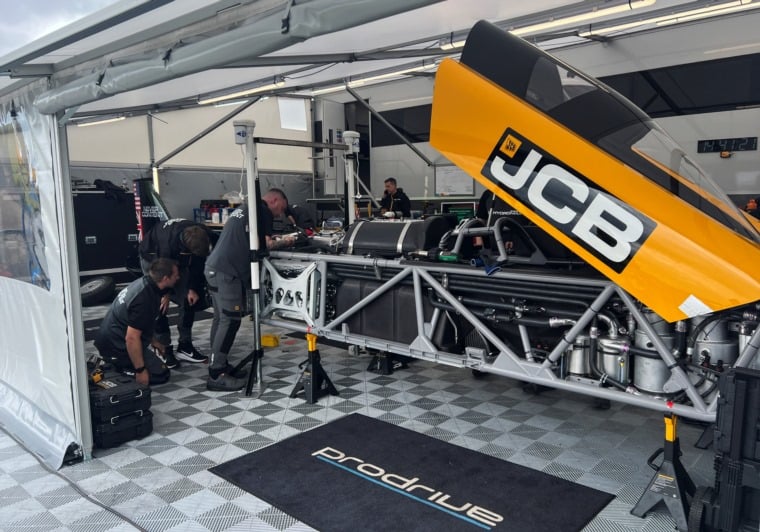
The HydroMax car is equipped with two hydrogen engines, each based on production models delivering 74 horsepower. These have been modified to generate a combined output of 1,600 horsepower with substantial torque.
During the record attempt, the HydroMax will push a volume of air equivalent to a bathtub every half second through a titanium turbocharger spinning at over 150,000 revolutions per minute and operating at nearly 300 degrees Celsius. The vehicle will consume slightly more than two kilograms of hydrogen and produce approximately 18 liters of water.
The two engines are mounted transversely, one at each end, to reduce height and are connected to transmissions from Xtrac. Green explained, "To give you an idea of how complex cooling an 800-horsepower hydrogen engine is, the engine pumps about one liter of oil per second. It contains seven liters of oil that completely circulates inside the engine every seven seconds."
He added, "Half of this oil volume is solely dedicated to preventing piston melting."