·
·


Tech & Science
China activated a $226 million underwater data center near Shanghai in May 2026, utilizing offshore wind energy and seawater cooling to enhance efficiency. This facility, located 35 meters below sea level, hosts around 2,000 servers and marks a pioneering step in subsea data infrastructure.

In May 2026, China commenced full commercial operations of its first underwater data center near Shanghai, a $226 million project situated 35 meters beneath the ocean surface. The facility integrates approximately 2,000 servers and draws over 95% of its electricity from a nearby offshore wind farm featuring more than 200 turbines.
This underwater data center represents the world’s inaugural wind-powered subsea facility to achieve full commercial status, according to Tom’s Hardware. It supports artificial intelligence workloads, 5G network infrastructure, and large-scale data processing tasks.
Earlier efforts by Microsoft, through its Project Natick running from 2013 to 2024, demonstrated promising hardware reliability underwater, with lower failure rates than land-based centers. However, Microsoft discontinued the project due to economic considerations and challenges in servicing submerged equipment.
China’s HiCloud Technology, collaborating with China Telecom, energy firm Shenergy, and infrastructure company CCCC, successfully transitioned this concept into a commercially viable underwater data center. Construction concluded in October 2025, followed by trial operations in February 2026 before reaching full commercial functionality in May.
One of the primary advantages of this underwater facility lies in its cooling system. Traditional data centers consume significant energy to cool servers, measured by Power Usage Effectiveness (PUE), where 1.0 is ideal and the industry average is roughly 1.5. This subsea center achieves a PUE below 1.15 by employing seawater as a passive coolant, reducing total power consumption by 22.8% compared to similar land-based centers.
Additionally, the center operates without using any freshwater, addressing critical water scarcity issues that affect data center expansion in many regions.
Operating underwater presents unique obstacles. Saltwater’s corrosive nature and the pressure at depth complicate hardware durability and maintenance. Since technicians cannot physically access the servers on the ocean floor, each module is engineered for autonomous operation over multiple years, with remote management systems overseeing daily functions and built-in redundancies mitigating hardware failures.
The initial phase delivers 24 megawatts of capacity, but HiCloud and its partners aim to scale up to a 500-megawatt subsea deployment in the future, as reported by Data Center Dynamics.
No comparable underwater data center projects are underway in the United States or the United Kingdom. U.S. policy, shaped by the CHIPS Act, prioritizes onshore infrastructure, while UK marine protection laws impose regulatory challenges that hinder similar developments.
At present, China leads in the deployment of operational underwater data center technology.
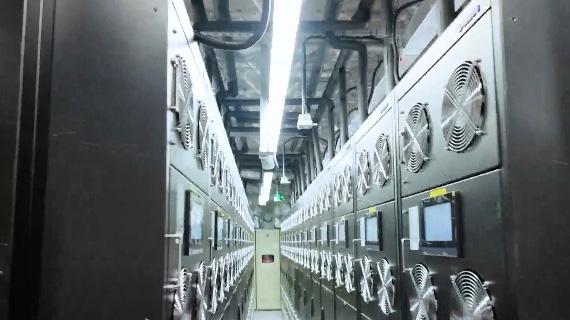
Interior of the underwater data center module near Shanghai. Photo: CMG