Tech & Science
Eclogite reveals 700C heat at 45km depth, defying models
A rock from Papua New Guinea descended to 90km, recording unexpectedly high temperatures at shallower depths that challenge subduction zone thermal models.

Thermal models of Earth’s crust face a significant revision after analysis of a rock sample from Papua New Guinea. The specimen recorded temperatures far higher than predicted during its descent into the mantle, specifically at depths where current theories assume cooler conditions.
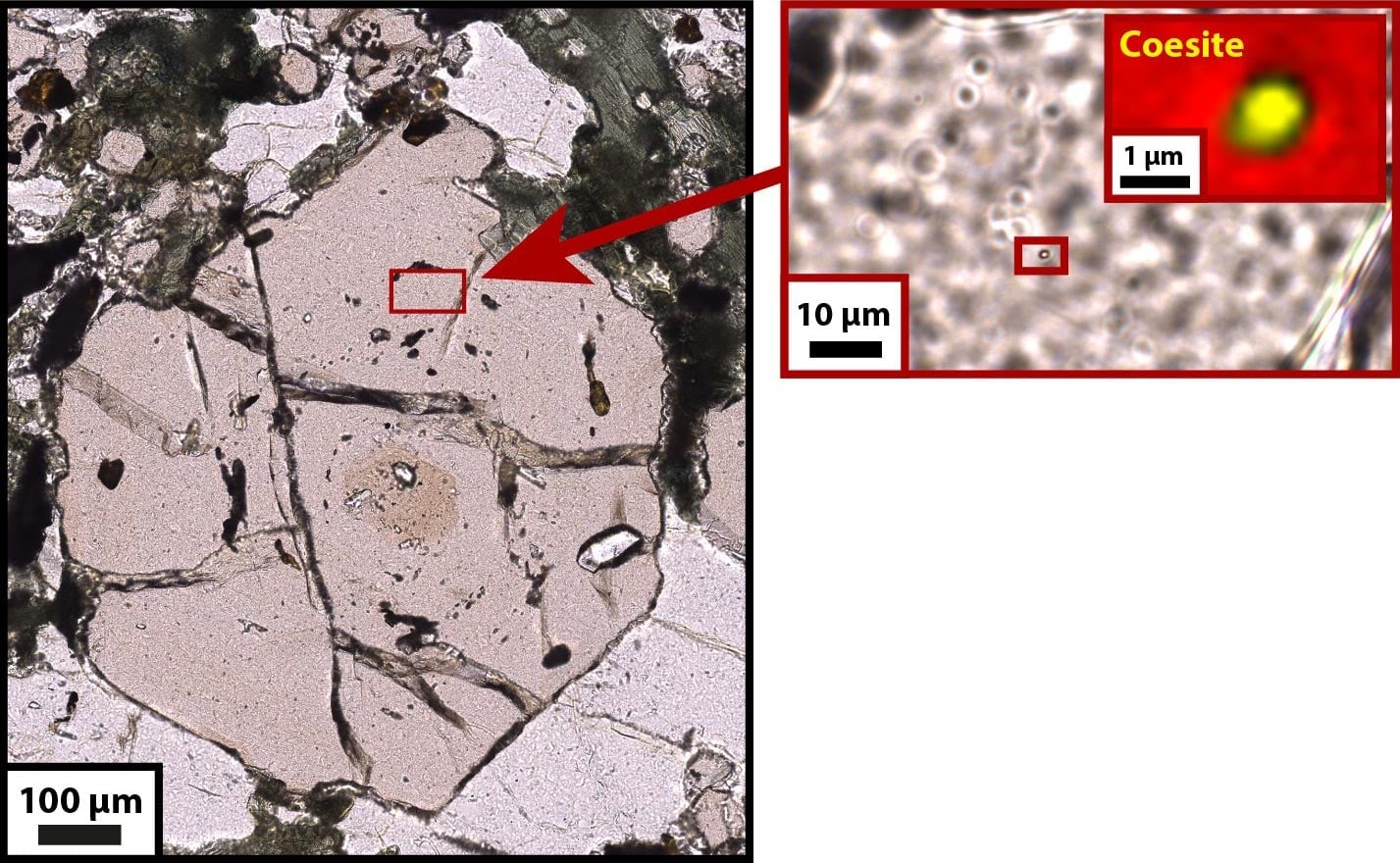
Microscopic Images of Garnet Crystal and Coesite Inclusion
Mineral evidence of deep burial
An international team led by Göttingen University reconstructed the geological history using eclogite, a red and green rock formed under extreme pressure in subduction zones. Published in Nature Geoscience, the study utilized analytical techniques to identify tiny coesite inclusions trapped within other minerals. Coesite formation requires immense pressure, confirming the rock reached at least 90 kilometers (56 miles) below the surface. At this maximum depth, the material experienced temperatures near 800°C (1,470°F).
Unexpected heat at shallow depths
The anomaly lies in the temperature gradient observed halfway through the journey. At approximately 45 kilometers (28 miles), the rock was only 100°C (180°F) cooler than it would be at full depth. This indicates it had already reached around 700°C (1,290°F) at half the depth. While deeper conditions aligned with the relatively cold pattern typical of subduction zones, the shallower phase was unusually hot. Dr. Jan Schönig of Göttingen University’s Geoscience Center noted that finding this shift from hot to cold contradicts existing thermal models for these regions.
Potential causes for thermal variance
Researchers propose two primary explanations for the excess heat at shallow levels. First, shearing stress generated as tectonic plates collide may heat rocks more intensely than previously assumed. Second, the specific subduction zone might not have had sufficient time to develop the lower temperatures expected in mature systems. Both mechanisms could have contributed to the observed conditions.
Implications for geologic processes
Accurate temperature data from subduction zones is critical for understanding earthquakes, volcanic activity, and chemical movement through Earth’s interior, including the long-term carbon cycle. These findings clarify how subduction operates over millions to billions of years and continues today. The research received funding support from the German Research Foundation (DFG).
Latest news

Finance Committee Discusses Additional 8.95 Trillion Lira Allocation for Electricity

Patriarch Al-Rai: Lebanon Needs Lasting Peace

Geagea: Lebanon Approaching a State That Monopolizes Military and Security Decisions