·
·


Tech & Science
An international team led by Imperial College London developed a quantum sensor that eliminates laser noise, enabling detection of faint cosmic signals like dark matter and gravitational waves.

Scientists have developed a quantum sensor prototype that effectively neutralizes disruptive laser noise, a major obstacle in detecting faint cosmic phenomena such as dark matter and gravitational waves. This advancement was achieved by an international collaboration led by Imperial College London.
The breakthrough represents a crucial step toward implementing long-baseline atom interferometers, which operate by splitting and recombining atom clouds using specialized lasers to measure minute atomic motion changes with high precision.
By comparing two atom clouds subjected to identical laser light, researchers aim to detect subtle differences in atomic behavior that could indicate the passage of gravitational waves or variations in exotic dark matter fields.
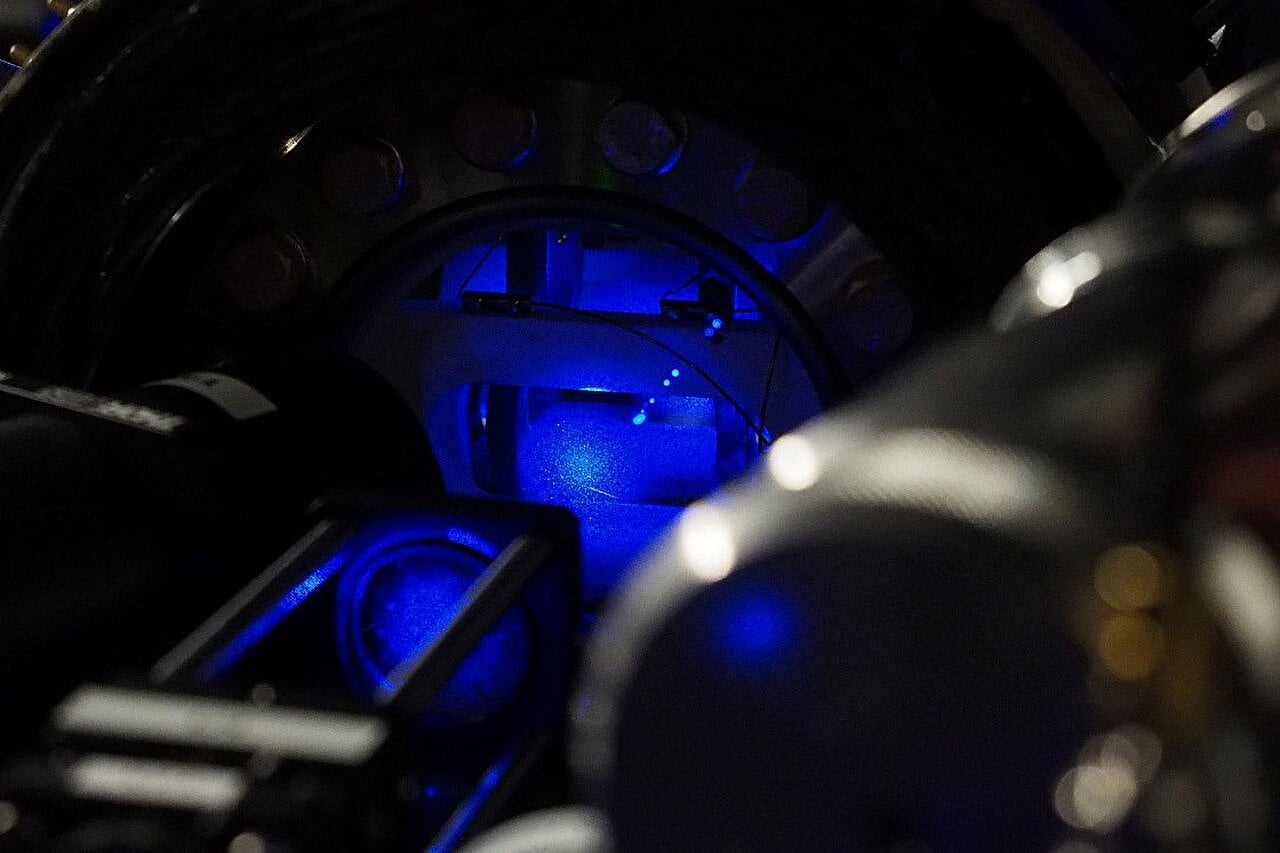
Although the theoretical framework of atom interferometry is robust, practical application has been hindered by significant engineering challenges. The lasers used to control the atom clouds generate intrinsic “phase noise” that is much stronger than the weak cosmic signals sought by researchers.
This internal laser noise overwhelms the data, preventing the identification of external cosmic influences unless effectively mitigated.
To overcome this, physicists proposed a differential configuration involving two separate interferometers. This setup allows the cancellation of shared laser noise when their data are compared. Prior to this study, the effectiveness of such noise cancellation under real experimental conditions had not been demonstrated.
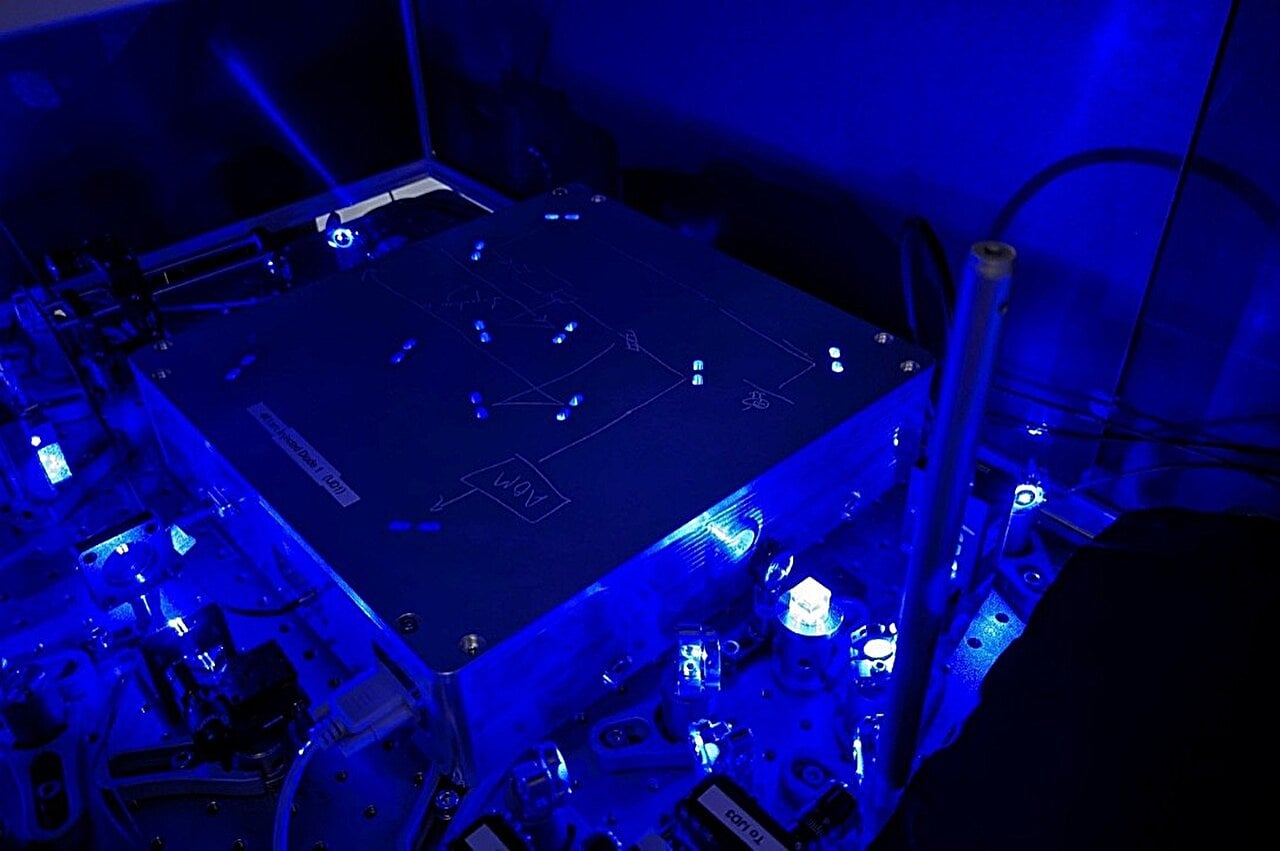
Researchers at Imperial’s Ultracold Strontium Laboratory built a specialized tabletop apparatus featuring two spatially separated clouds of strontium-87 atoms cooled near absolute zero and levitated using blue laser light. Both clouds were monitored by a single, highly stable clock laser system.
To rigorously test their noise-cancellation method, the team introduced large amounts of artificial phase noise into the system, exceeding typical laboratory fluctuations. Initially, this noise destroyed the interference patterns, making each interferometer unusable individually.
However, when the data from both atom clouds were mathematically combined, the shared laser noise was eliminated, revealing the underlying signal at the fundamental quantum mechanical limit.
To validate the sensor’s capabilities, the scientists added an oscillating frequency that simulated the signature of a dark matter field or a passing spacetime distortion. Despite being obscured by intense background noise, the differential interferometer pair successfully detected the target signal with high accuracy.
This successful demonstration paves the way for scaling the technology to international facilities. The technique is integral to next-generation atom interferometer projects, including the MAGIS facility at Fermilab and the proposed AICE infrastructure at CERN.
By transitioning from theoretical concepts to validated hardware, this quantum sensor breakthrough ensures that future large-scale observatories will have the sensitivity required to map the universe’s invisible structure.