·
·


Lebanon
A joint UN and Lebanese evaluation estimates agricultural production losses in southern Lebanon at over $530 million, highlighting extensive damage from the war.

A comprehensive scientific assessment of agricultural damages and losses in southern Lebanon's war-affected areas has revealed unprecedented impacts on the agricultural sector. These include damage to infrastructure, agricultural production, farmers' livelihoods, food security, and rural development.
The evaluation was conducted collaboratively by the National Council for Scientific Research – Lebanon (CNRS-L) and the Lebanese Ministry of Agriculture, with technical coordination and support from the United Nations Development Programme (UNDP), the Food and Agriculture Organization of the United Nations (FAO), and the World Food Programme (WFP). Its purpose was to provide an accurate scientific basis for estimating the extent of damage and to establish priorities for intervention, recovery, and reconstruction.
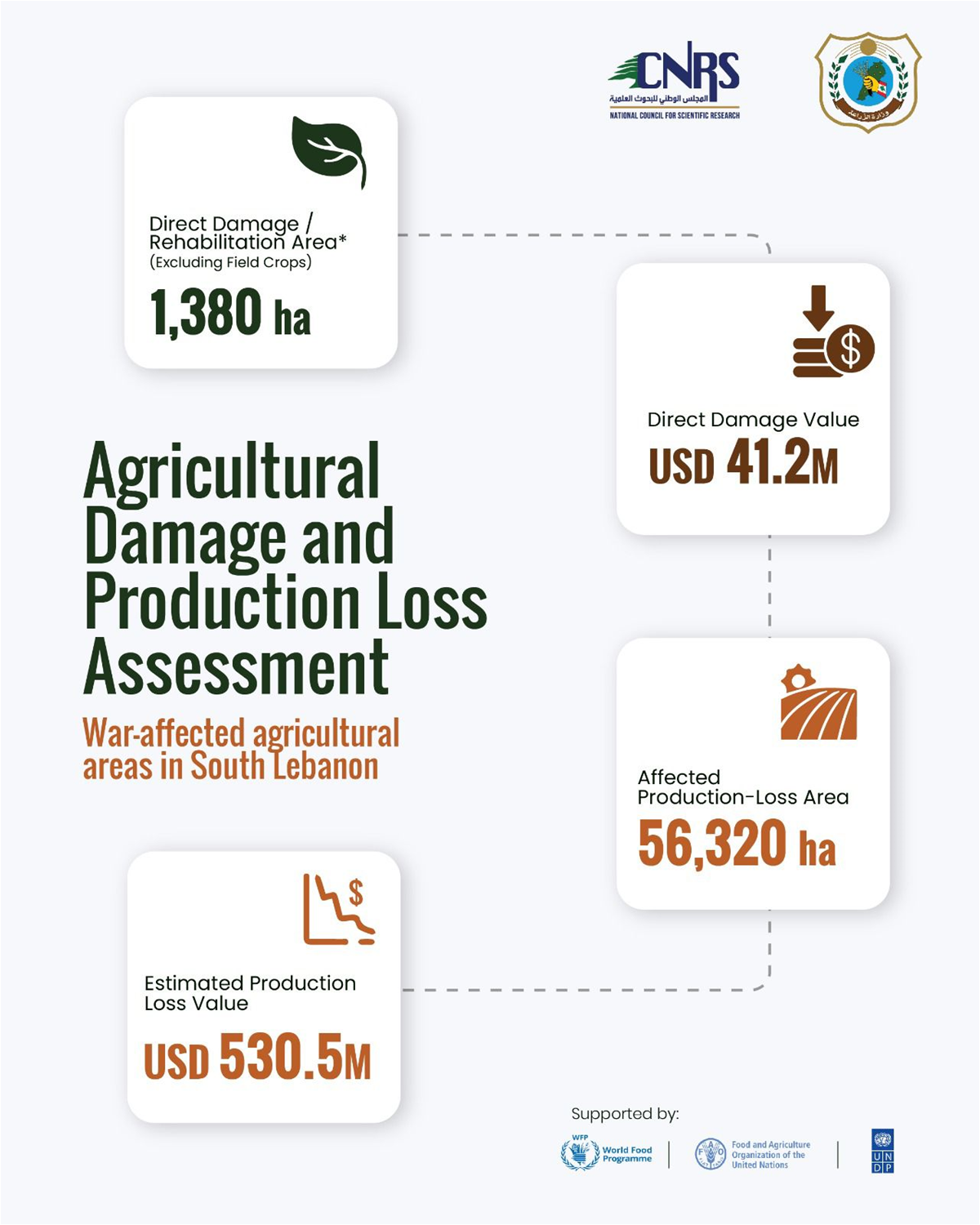
Findings indicate that direct damages to the agricultural sector in the conflict-affected regions amounted to approximately $41.2 million. These damages encompassed agricultural lands, orchards, production facilities, agricultural infrastructure, equipment, and production-related tools.
The assessment also identified that the area directly affected and requiring rehabilitation and land reclamation—excluding field crops—reached around 1,380 hectares. This necessitates specialized programs to restore the damaged lands and recover their productive capacity.
In contrast, the study showed that the largest economic impact was due to agricultural production losses. The area affected by production losses covered about 56,320 hectares, resulting from restricted access to agricultural lands, halted or reduced farming activities, lost production seasons, and disruptions in supply and marketing chains.
The total estimated value of agricultural production losses was approximately $530.5 million, reflecting the profound effect of the war on the local agricultural economy and on the income of rural households, many of which depend directly or indirectly on agricultural activities.
The report emphasized that production losses constitute the largest share of the total economic damages to the agricultural sector. This is attributed to multiple conflict-related factors, including decreased productivity, interruption of agricultural operations, increased production costs, difficulties accessing markets, and negative impacts on natural resources and local agricultural systems.
This assessment serves as a fundamental scientific and national reference to guide recovery and reconstruction efforts in the agricultural sector. It also provides a reliable database to support strategic planning and to identify priorities for national and international investments and interventions aimed at restoring agricultural activity and strengthening the resilience of affected rural communities.
The study's contributors confirmed that the evaluation results offer a practical tool to direct resources toward the most affected areas. This will contribute to rehabilitating agricultural lands and production infrastructure, restoring the sector's productive capacity, enhancing food security, and achieving sustainable economic and social recovery in southern Lebanon.
Key Findings of the Assessment
The area directly affected and requiring rehabilitation and reclamation (excluding field crops): 1,380 hectares.

Value of direct damages: $41.2 million.
Area of land affected by production losses: 56,320 hectares.
Estimated value of agricultural production losses: $530.5 million.
This evaluation is part of national and international efforts to document the war's impact on Lebanon's agricultural sector and to establish a solid scientific foundation for recovery and reconstruction programs. These efforts aim to ensure the restoration of agricultural production, protect farmers' livelihoods, and promote sustainable rural development and food security in the affected areas.