·
·


Lebanon
A former Israeli Mossad officer reveals unprecedented details about the 'Pager Explosions' operation that targeted thousands of Hezbollah members in September 2024 by detonating their communication devices.

A former officer in the Israeli "Mossad" revealed unprecedented details about the "Pager Explosions" operation, which targeted thousands of members of the "Hezbollah" militia in September 2024 by detonating their communication devices.
In an interview with the "Jerusalem Post" newspaper, the officer Adam Fine, (a pseudonym for a retired Israeli security official, according to the newspaper) described the operation as "one of the most dangerous and complex Israeli intelligence operations."
The officer, who recently published a book about the operation titled "The Fateful Message," says that the Mossad relied on a complex infiltration of the supply chain, through real individuals and companies that had previously dealt with Hezbollah.
He explains that a woman named "Teresa" played a pivotal role in convincing the party to increase its order from 500 devices annually to 5,000 devices in March 2024, as part of a campaign led by a Mossad official under a commercial cover.
He reveals that the Mossad faced enormous challenges in preparing this large number of devices in a short time, to the extent of converting the gym and recreation areas inside its headquarters into temporary production lines for assembling the pagers.
He points out that the Mossad feared that Iran would discover the operation due to its advanced technical capabilities compared to Hezbollah, and a wide discussion took place within the party about purchasing the new devices, amid suspicions and warnings of a potential security breach, but the need to replace old communication devices pushed the party to proceed with the deal.
He says that a wide discussion took place within the party about whether to buy the pager devices. There were indeed voices opposing the new device.
The party was dealing with additional suspicion when a manufacturing company came to offer a product, instead of the party itself initiating contact with the company. The opponents of the new device said that the party first needed to conduct a thorough examination and review competing options.
Fine pointed out that one of the factors that pushed the deal forward was that the communication device the party was using was no longer sold, forcing it to change regardless of the cost.
Fine explained that the party considered every transition to a new device a major risk and an opportunity to reassess the market and available products, which gave the Mossad a very narrow window to infiltrate the party's supply chain. He pointed out that any small change in the supply network between Taiwan and Lebanon would have prompted Hezbollah to demand precise explanations.
The book shows the scale of the challenge the Mossad faced in finding a person capable of convincing Hezbollah to overcome its suspicions. Fine also explained that the party's technology guards were looking for listening devices, not explosives, which gave the Mossad a decisive advantage.
How "Teresa" Convinced the Party
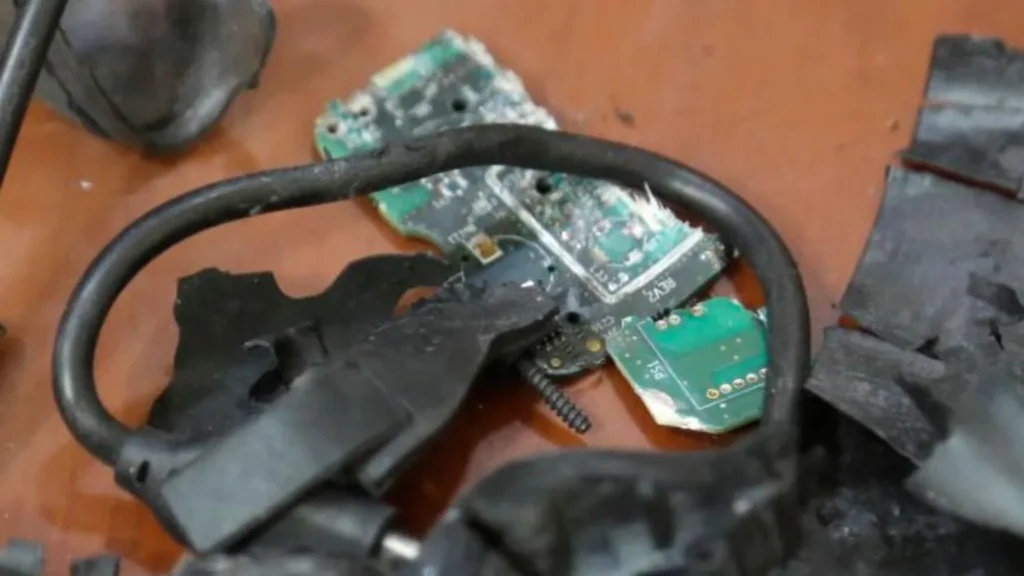
The book mentions how the Mossad lured a Hezbollah element into an ambush to prevent him from exposing the devices, and how it used a third party who was unaware of the plan.
Fine talks about the intermediary "Teresa" who received a call in March 2024 from "Hezbollah" requesting to increase its order of pager devices from 500 devices annually to 5,000 devices. He says this huge leap did not happen by chance, but was part of a campaign led by a senior Mossad official named "Einat," who contacted Teresa under the guise of a businesswoman named Lily.
Teresa belonged to an already existing company that had previous dealings with Hezbollah. Fine says "the company was real, and Israel did not control it," adding that this formed a very powerful mix to infiltrate the supply chain of a highly suspicious group like Hezbollah.
The original deal, which later multiplied enormously, was only accomplished through a combination of Teresa's previous relationship with the head of "Gold Apollo" company Hsu Ching-Kuang, and through Lily's instructions to Teresa on how to deal with him and convince him.
The book addresses sharp internal discussions within the Mossad that began in 2019 about the feasibility of developing a new operation using pager devices alongside the old walkie-talkie plan. Some officials expressed fear that any failure would expose both operations together and lose years of secret work.
Fine explained that the pager devices were more flexible than the walkie-talkie devices, because they could be used in times of peace and war, while the walkie-talkie devices were linked to specific field conditions.
The book also revealed a dispute between the Mossad and the Israeli army over the timing of executing the operation in September 2024. While the Israeli Chief of Staff believed that the timing of the war might not be appropriate, the Mossad considered that the operation had reached a stage from which there was no turning back.
In the end, the explosions were carried out sequentially, via the pager devices and then the walkie-talkie devices, causing a state of widespread confusion within Hezbollah, and paving the way for subsequent Israeli strikes.
Fine points out that the operation was not just an intelligence success, but the product of years of complex secret work.
Erem News