·
·


Tech & Science
Researchers at Xidian University are advancing space-based solar power technology to transmit energy wirelessly from geostationary orbit to Earth.

Scientists at Xidian University in China are advancing technology to capture solar energy in space and wirelessly send it to Earth from geostationary orbit, approximately 36,000 kilometers away.
The initiative, named Zhuri or “chasing the sun,” aims to create systems capable of beaming power over a distance of 22,369 miles, potentially addressing terrestrial energy shortages.
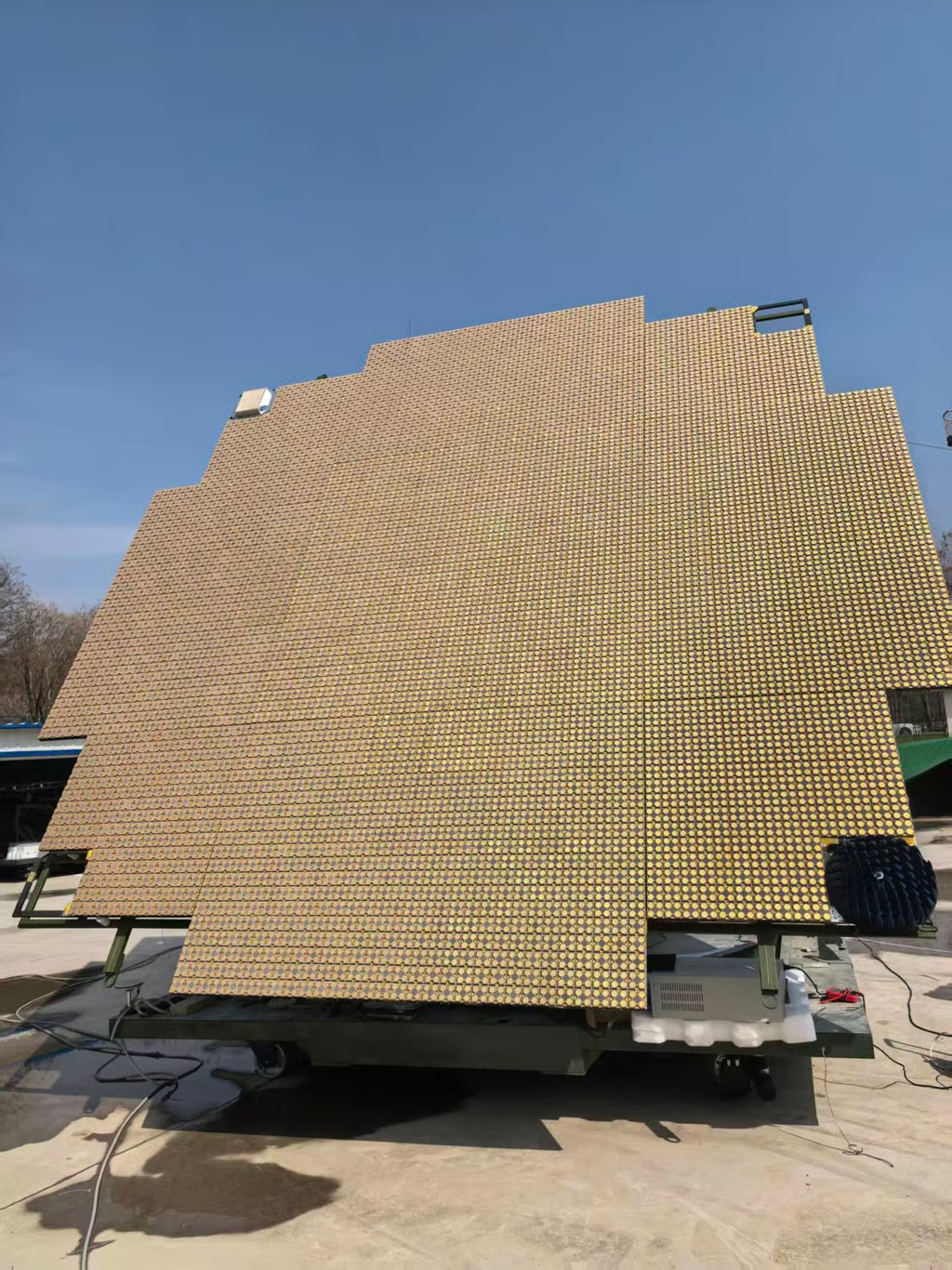
At the university campus in Xi’an, Shaanxi province, associate professor Fan Guanheng and his team have demonstrated critical components of their space solar power system. They utilize a 4.8-meter dome-shaped mirror, suspended from a 75-meter tower, to concentrate sunlight onto solar panels.

The electricity produced is then converted into microwaves and transmitted across 100 meters to a rectenna, which transforms the microwaves back into usable electricity. Recent experiments achieved power transmission at kilowatt levels and demonstrated the ability to direct energy to multiple moving targets simultaneously, as reported by an expert review panel last month.
The researchers are also testing Fresnel lenses ranging from 2 to 7 meters in diameter, which efficiently focus light while using cooling fluids to manage heat with less material.
In an interview with the South China Morning Post, Fan described the process in three stages: concentrating light, converting and transmitting microwaves, and rectifying the energy. Testing occurred during peak sunlight hours, between 10 a.m. and 3 p.m.
Space-based solar power offers advantages over terrestrial solar installations, including solar energy density in orbit that can be six times higher than on Earth’s surface. It is unaffected by night cycles, weather conditions, or atmospheric interference.
“That is why space-based solar power is a potential way out of the energy crisis on Earth,” Fan stated.
The project is led by Duan Baoyan, an electromechanical engineer and former president of Xidian University. Inspired by NASA’s SPS-ALPHA modular satellite array concept from 2012, Duan envisions large-scale systems, with a one-gigawatt station—enough to power a mid-sized city—requiring mirrors spanning hundreds of meters.
Challenges include developing deployable foldable or self-assembling structures, achieving precise microwave targeting, and ensuring the safety of aircraft and the environment from the energy beams.
Xidian’s design employs modular units flying in formation instead of a single large structure, enhancing system resilience and ease of maintenance.
China is among the leading countries in this field, alongside the United States and Japan. While orbital deployment remains a long-term objective, nearer-term applications include wirelessly charging satellites in orbit or powering lunar bases from orbit or the Moon’s surface.
The immediate goal for the team is to obtain funding for orbital experiments. Success could enable continuous, high-efficiency clean energy, potentially transforming the global energy supply.