·
·


Tech & Science
Waymo has introduced the Ojai, a Chinese-made electric robotaxi, now offering free rides to select customers in three US cities as it prepares for broader deployment.

Waymo has begun providing a limited group of riders in Los Angeles, Phoenix, and San Francisco with free access to its latest robotaxi model, the Ojai, an all-electric minivan designed to reduce operational costs and withstand heavy usage.
The Alphabet-owned company announced on Thursday that it plans to extend availability of the Ojai—a modified minivan produced by Zeekr—to additional cities and a wider customer base. Currently, the initiative focuses on collecting user feedback to enhance the robotaxi service.
The Ojai’s introduction follows extensive development and testing aimed at delivering a vehicle that is affordable, comfortable, easy to maintain, and cost-effective to manufacture and operate.
This rollout coincides with a period of operational challenges for Waymo, which recently halted robotaxi services on freeways in Los Angeles, Miami, Phoenix, and San Francisco to improve vehicle performance in construction zones. The company also paused services in Atlanta and San Antonio to address flooding issues.
While the new blue minivan does not resolve all of Waymo’s difficulties, it represents a significant opportunity for scaling its fleet and generating revenue.
Although equipped with Waymo’s proprietary hardware and software, the Ojai is built on a platform developed by Zeekr, a brand under China’s Geely Holdings. The two companies formed a partnership in 2021 and unveiled a concept robotaxi in late 2022. Since then, Waymo has conducted nearly two years of public road testing with both prototype and production-intent versions of the vehicle.
Designed in Sweden, the minivan is based on Zeekr’s SEA-M architecture, an evolution of the Sustainable Experience Architecture (SEA) tailored for future mobility solutions such as robotaxis and logistics vehicles.
The Ojai features Waymo’s sixth-generation autonomous driving system, which includes 13 cameras, four lidar sensors, six radar units, and multiple external audio receivers. This modular system is central to Waymo’s commercial plans, allowing deployment across various vehicle types, including the Zeekr minivan and the Hyundai Ioniq 5, both previously announced.
The design of the Ojai incorporates technological advancements and operational insights gained from providing over 500,000 paid robotaxi rides weekly. It is also intended to accelerate the expansion of Waymo’s fleet, which currently consists of approximately 3,700 Jaguar I-Pace vehicles.
Zeekr delivers stripped-down vehicles to Waymo’s factory in Arizona, where they are outfitted with the company’s autonomous driving technology and other features. Waymo aims to scale production to tens of thousands of units annually, starting with the Ojai and followed by the Hyundai Ioniq 5.
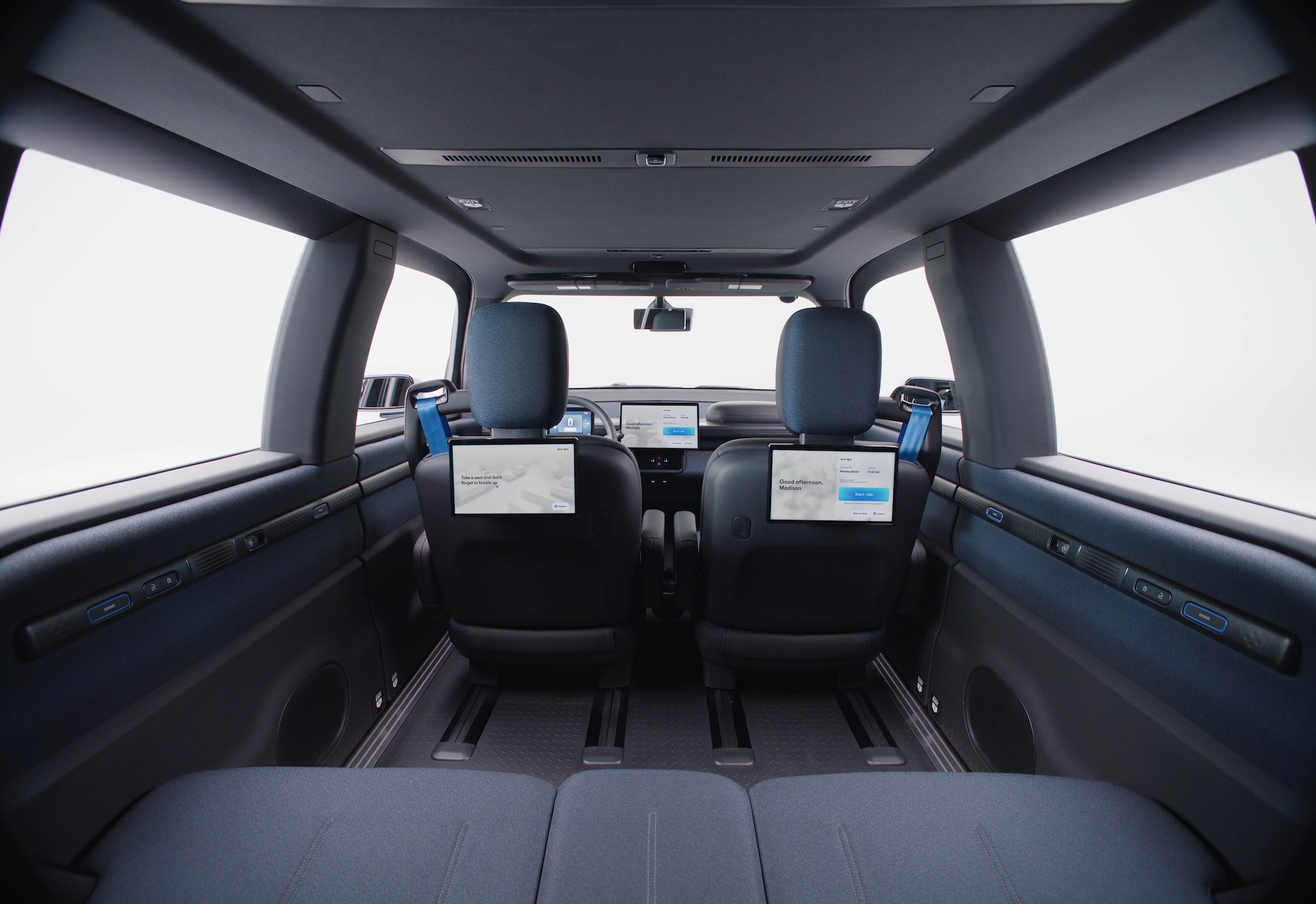
The vehicle offers a flat floor, low step-in height, and gondola-style doors on both sides to facilitate easier passenger entry and exit. Additional rider-focused features include charging ports, cup holders, expanded legroom and headroom, grab bars, braille labels above various buttons, and three large adaptive screens that allow passengers to view the route, adjust music, climate settings, and access rider tips.
The Ojai’s interior is designed for easier cleaning, faster charging, and includes a modular construction along with increased battery capacity, all contributing to lower maintenance costs and improved repair efficiency.