

Lebanon
Karami Calls for Careful Reading of Decision 1513 and Rejects Strike
Lebanese Education Minister Reema Karami addressed the press regarding the secondary teachers' union strike, urging a careful reading of Decision 1513 and emphasizing partnership with unions to ensure educational stability.

Minister of Education and Higher Education Reema Karami held a press conference at her office in the ministry, dedicated to presenting the ministry's stance on the open-ended strike call issued by the Union of Official Secondary School Teachers. The event was attended by Director General of Education Fadi Yarak, Director of Secondary Education Khalid Fayyad, Director of Basic Education George Daoud, and several advisors.
Karami stated: "I gathered you today to speak and express the ministry's position on what is happening with the Union of Official Secondary School Teachers, especially in light of positions reaching public opinion as if there is a confrontation between the union and the ministry. Therefore, I wanted to present a number of facts to explain the ministry's position, and to once again call on the unions to read carefully the decision that lies at the root of the dispute they are talking about."
She added: "I also return to repeat that I consider the unions partners. My approach to matters with them since assuming my duties at the ministry has been that they are a partner entity with a role to perform, an entity carrying the message of the teaching body, a demand-side entity interacting with the Ministry of Education, which is the executive authority for laws and regulations in force. Each of us shares the same concern, which is the future of the educational sector. This is important because it serves our students, and we consider it closely linked to the future of our country. However, each party, while pursuing this common goal, does so from its own position and within its powers and roles. We, at the Ministry of Education, as an executive authority, have the duty to apply the laws in force, as well as the internal regulations of official schools and secondary schools, and to commit to issuing decisions that take into account the circumstances we are going through at a given time."
She continued: "The decision currently being discussed is Decision 1513. I would like to talk about the background of its issuance, starting from the 2026 Budget Law, specifically Article 56, which stipulates that the Ministry of Education is prohibited during the current academic year from making any contract other than the original contract made through the Civil Service Board. Consequently, this matter became binding, and we, as a ministry, must apply it. We followed this up by drafting a decree to convert the contracts of teachers who were contracted under funds, including those assisted in morning shifts, into original contracts."
She further said: "We also received Opinion No. 2319 from the Civil Service Board, which relied on Law 630, and set very strict conditions on how we conduct original contracting. It emphasized studying the actual needs in official secondary schools and schools, based on which these contracts can be adopted and converted to original status. At the same time, we are part of a reformist government bearing the concern of organizing the public sector. Under this heading, there are recommendations from the Ministry of Finance and from donor agencies, which we consider in the Ministry of Education as a source of funding for the educational sector, and a source that enables us to make commitments to teachers. Because if we make any contract with teachers without providing the necessary appropriations for this purpose, we would violate our duties. Therefore, studying the needs was fundamental for us."
She said: "What happened is that after the start of this academic year, and following the delay resulting from parents' late registration of their children—although we called on them to do so since July—they delayed and started registering. We waited for this to know the number of students, classes, and the needs of schools and secondary schools. Then we began the studies, and numbers emerged that, according to the systems and laws in force, amount to violations. Currently, in our official secondary schools, we have one supervisor for every 56 learners, although the last decision regulating this process stipulated that we should have one supervisor for every hundred learners. Seventy-six percent of our official secondary schools are violating this regulation. The current situation shows, for example, that there is a secondary school with about 90 learners and 8 supervisors, meaning there is one supervisor for every 11 learners, not for a hundred."
She added: "I considered previous years exceptional, requiring unusual decisions. We are approaching a year in which we strive, as much as possible, to prove to those concerned with funding this sector, as well as to parents whose trust in this sector is gradually fading, that it is a sector capable of managing itself, determining its priorities, and investing the resources placed in it in the best way. Based on this, the decision was issued to organize these matters."
She continued: "I would like to share with you some figures that personally surprised me. In certain places, we have 30 learners in a specific age stage. The decision does not only relate to the distribution of supervisors, which was the point of disagreement, but also includes branching and how it is adopted. I would also like to express great surprise at the reaction of the Secondary Education Union and their call for a strike, despite the fact that we met with them for two hours, during which we discussed this organizational decision that meets about ninety percent of the issues exactly as agreed upon. The only modification was that instead of adopting the internal regulation stating one supervisor per 150 learners, we unified the criteria and said that in the intermediate stage or in secondary school, we will adopt 125 learners per supervisor."
She said: "I would like to clarify here that many of our secondary schools include the third cycle, which is the final stage of basic education, so we adopted the figure of 125 per supervisor. We also expressed our understanding of the exceptional circumstances the country is going through, so we reorganized this sector and included a clause in this decision noting the exceptions that schools and secondary schools may submit individually, whether regarding the number of supervisors, taking into account the nature of the building, the size of classrooms, and the attracting secondary schools experiencing pressure and demand from parents. Thus, they are entitled to exceptions to obtain a larger number of supervisors to help principals. Exceptions can also be made regarding how branching is done, such as integrated schools or those entering development projects. We also spoke about secondary schools in remote areas covered by exceptions, as there is no alternative around them."
She added: "In the ministry, we are committed to securing a seat for every learner. Our concern in every decision we take is not to lose this opportunity for our students. We applied all these exceptions and more, and adopted a special exception for occupied areas, which are not covered by this decision at all, whether in secondary schools or schools. Similarly, we will handle mercy requests coming from the South or Nabatieh specially, taking into account significant changes in these schools regarding increased numbers due to displacement or decreased numbers for the same reason."
She continued: "This is the picture we see in the Ministry of Education. Duty calls us to issue a decision that takes into account all data. Teachers' demands are a fundamental factor, but we all know they are not the sole factor for a successful academic year. There are many other factors. It is the duty of the Ministry of Education, its general directorate, the Directorate of Secondary Education, the Directorate of Basic Education, and the experts sitting around this table to see what the best possible solutions are to issue fair decisions. Through these, we become organized and able to reach the standards required of us, namely rationalizing spending and justice."
She further said: "When we take a specific organizational decision and the budget is limited, we must ensure that we do not place many resources in certain schools while neglecting others. The limitation of these resources is an opportunity for all of us to prove that we are capable of managing this sector in a rational, transparent manner that applies laws, where violations are justified exceptions under specific circumstances. If we want to do this, we must unite to launch this academic year."
The Minister of Education said: "We issued the decision to pass the academic year. In parallel, we are working with the Center for Educational Research and Development to amend the entire internal regulation, because our new curricula will require very different arrangements to prepare the learning environment for implementing these curricula. We are issuing this decision amidst huge economic pressure. We cannot tell any party that our classes have fewer than ten students but we desperately need assistance. Nor is it right for us to boast when we say we can spend between $500 and $1000 to educate our students, while the current cost is between $4000 and $8000 per learner, because in certain places we did not comply with prevailing laws and regulations. If we continue on this path, we will not comply with the conditions of the Civil Service Board, which will not be able to approve contracting according to proper procedures if we do not meet these conditions."
She added: "I would like to note that during the press conference, a representative from my side is negotiating with persons authorized by the Secondary Education Union to reach a common understanding and return to the point that unites us, which is the interest of the learners and preserving the sector, which is currently facing a great risk regarding parents' trust. The risk is also due to limited funding, which no one agrees to increase unless we show our commitment to working in a disciplined manner and succeed in organizing the sector."
She concluded: "I hope this press conference is seen as a message and an outstretched hand for greater openness among us. Let us prove that it is unacceptable in the profession of teaching to take any student hostage. In this profession, everyone who cares about the official school and its students can only act from the standpoint of partnership, pure and good intention, and trust in this government, which is exerting its effort to restore its role, so that through it we become organized and able to reach the standards required of us, namely rationalizing spending and justice."
Latest news

New Target Bank Without Geographic Restrictions: Why Does Iran Threaten European Capitals?
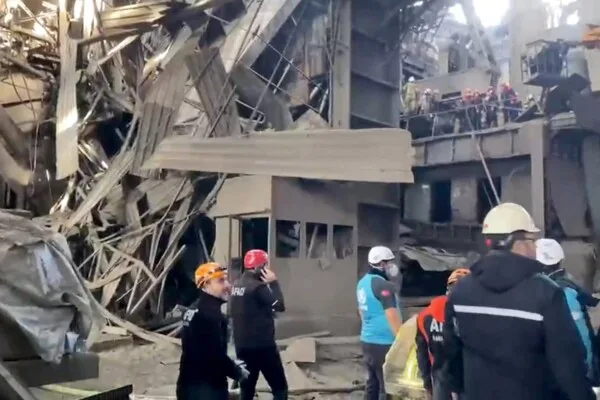
Death Toll in Izmir Factory Explosion Rises to 16; Erdogan Launches Investigation
Even If Heaven Is Denied: Trump Refuses to Forgive Two of His Top Rivals
