

World
Battles to Restore Influence: Trump's Next Options After Losing Congress
Donald Trump faces a turbulent political phase after Republicans lost control of both chambers of Congress, prompting speculation on his next moves.

US President Donald Trump is preparing to enter a more turbulent political phase following the Republicans' loss of control over both chambers of Congress, a development that threatens to diminish his influence and turn him into a "lame duck" for the remainder of his term.
The newspaper "The Independent" suggests that Trump may resort to displaying power domestically and internationally to compensate for his declining authority, signaling a period filled with confrontations and tensions.
Lame Duck
The paper stated that Trump will find limited consolation in making historical precedent, as he became the first US president in more than a century to become what is known as a "lame duck" twice during his political career.
This term refers to a president whose ability to exert political influence wanes as their term nears its end, especially when their party loses control of Congress.
The last historical example of this situation dates back to President Grover Cleveland, who lost the 1888 election before returning to the White House more than four years later.
However, Trump's situation differs this time, as the Twenty-Second Amendment to the US Constitution prevents him from running for a third term, making the end of his presidential career a foregone conclusion.
Despite these facts, Trump has not shown willingness to acknowledge his declining influence; instead, he quickly downplayed the significance of the election results, stating via his platform "Truth Social" that he was not a candidate in them, and that Republicans would have achieved a landslide victory had he run himself.
These remarks recall Trump's behavior after losing the 2020 election to Joe Biden, when he promoted claims of electoral fraud and being deprived of winning a second term.
Therefore, questions arise regarding the nature of the upcoming phase, and whether he will deal with his declining influence calmly or escalate his actions to regain the initiative.
Trump's Options
In this context, Iran emerges as one of the most prominent potential arenas for escalation, as Trump is accustomed to facing challenges threatening his authority by displaying military power.
Speculation has increased in Washington regarding the possibility of launching new US strikes against Iranian targets, particularly after a classified briefing on military options was presented to legislators from both parties prior to the elections.
Meanwhile, these plans raised concerns among Democrats, as Senator Chris Murphy described them as insane, warning of the possibility of pushing the conflict toward destructive escalation, at a time when American voters are demanding an end to the war quickly.
Additionally, right-wing commentator Tucker Carlson warned of the possibility of the Trump administration approaching the execution of a nuclear strike against Iran, although the US president previously ruled out using such weapons.
In contrast, Vice President JD Vance blamed the war for the Republicans' loss of control over both chambers of Congress, an assessment Trump acknowledged as largely correct.
Faced with these pressures, Trump confronts two main options; either escalating the confrontation by targeting sensitive Iranian facilities, including the Mountain Axe facility linked to the nuclear program, or settling for the current defensive US strikes.
Improved oil shipping movements through the Strait of Hormuz might lead to maintaining the existing approach, but Trump may see his political losses as an opportunity to proceed with his pledge to prevent Iran from possessing nuclear weapons.
Turbulent Legacy
Trump's options are not limited to Iran, as presidents whose domestic authority declines often resort to foreign files to bolster their political legacy.
In this framework, Trump may intensify pressure on Ukrainian President Volodymyr Zelensky to end the war with Russia according to terms favoring Russian President Vladimir Putin.
In a development that could alarm Western and Asian capitals, the possibility of reaching a tripartite agreement involving Trump, Putin, and Chinese President Xi Jinping emerges, aimed at redistributing international spheres of influence.
The Chinese Ministry of Foreign Affairs indicated the existence of talks with relevant parties regarding holding a possible trilateral meeting on the sidelines of the Asia-Pacific Economic Cooperation (APEC) summit this month.
On the other hand, Trump may move towards exerting pressure to change the communist regime in Cuba, a step contradicting the approach followed by former President Barack Obama, who worked to normalize relations with Havana during the period following the 2014 midterm elections.
But the possibility of Trump being preoccupied with personal interests remains, as he may exploit his foreign trips to enhance his family's wealth.
In contrast, the Supreme Court provides him with broad legal protection, having ruled in 2024, in the case of "Trump v. United States," that presidents enjoy immunity from criminal prosecution for official acts performed while in office.
Domestic Battle
Internally, Trump is expected to rely more heavily on executive orders to pass his policies, given the Republicans' loss of control over Congress.
He can also use the veto power against legislation passed by lawmakers, noting that he used this prerogative 12 times during his two presidential terms, and Congress managed to override his objection only once.
Trump also relies on the loyalty of officials managing the Department of Justice and the Federal Bureau of Investigation, in addition to appointing Stephen Miller, one of the most prominent hardline figures in the MAGA movement and the chief architect of the immigration crackdown campaign, as White House Chief of Staff.
This appointment reflects the president's adherence to his loyal circle, despite the messages carried by the election results.
Trump's Projects
As another indicator of his interest in personal projects, Trump signed a proclamation preventing future presidents from altering the design of the Oval Office and the Cabinet Room.
He defended his decision by arguing that the modifications he introduced represent an achievement worth preserving, whereas Obama had previously criticized the appearance of the office during his campaign.
Furthermore, the project to build a 250-foot-high arch of triumph, named the "Trump Arch," sparked new controversy after a federal judge halted its construction, despite receiving approval from a federal commission.
This stems from the project lacking authorization from Congress, which will come under Democratic control in January 2027.
Thus, the legal and political battle surrounding the arch may become a real test of what remains of Trump's influence.
The project, aspiring to be crowned with golden eagles spreading their wings, may become a symbol of his personal ambitions and the limits of his power simultaneously, leaving the question: Will the US president manage to complete this monument before his term ends, or will political constraints prevail over his efforts to immortalize his name?
Latest news
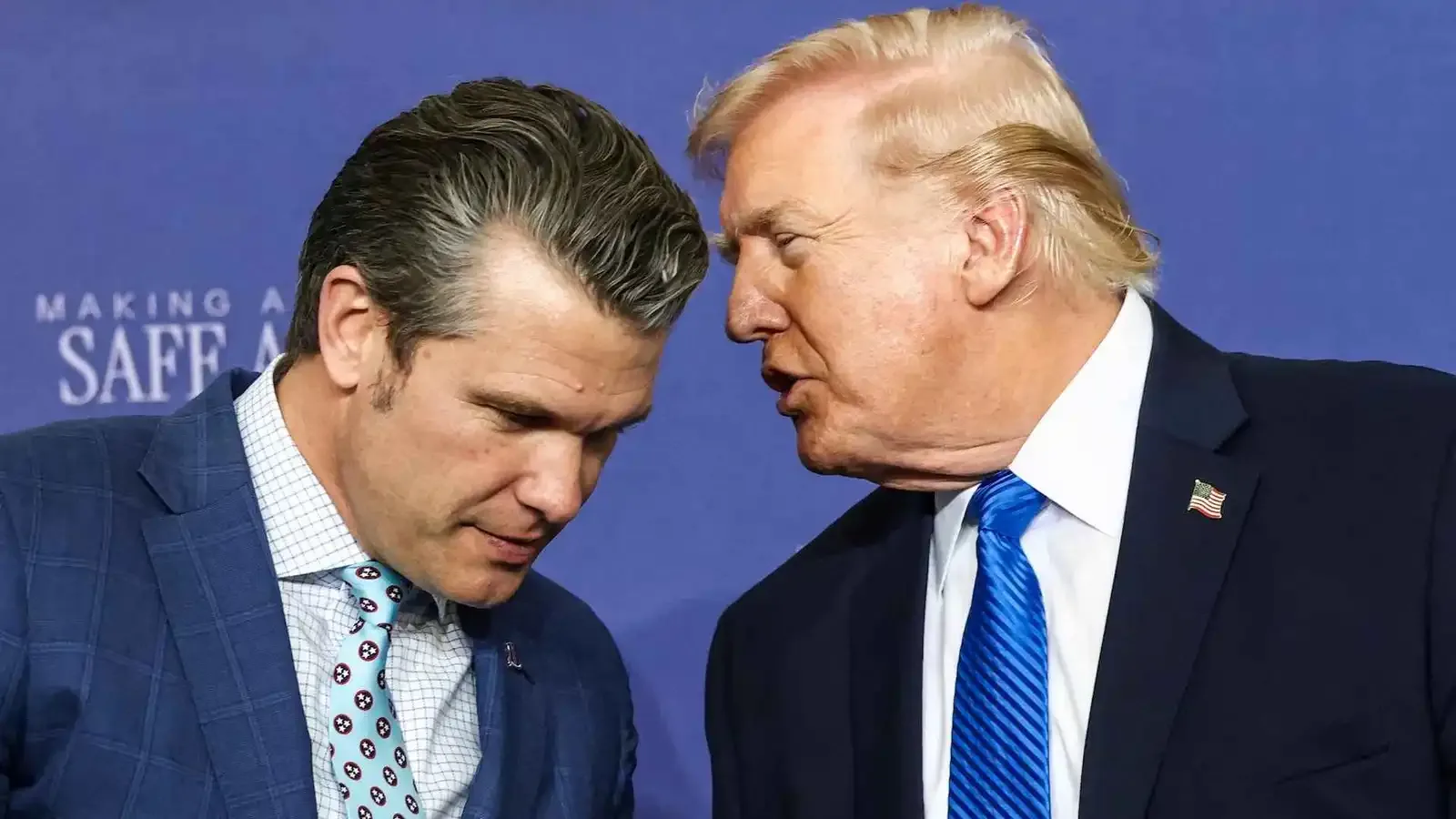
Trump Affirms Confidence in War Secretary, Hints at 'Limited Changes' to His Administration

Niger: Military Mobilization Ahead of Large-Scale Operation Against Armed Groups
Full Traffic Closure Between El Mdeirij and Bekaa for Paving Works on Damascus International Road
