·
·


Tech & Science
Researchers developed a battery that harnesses energy from ordinary air humidity, offering new possibilities for IoT devices and medical equipment.

Scientists from the University of North Carolina, in collaboration with researchers at Rice University, have created a battery that derives part of its energy from the normal moisture present in the surrounding air.
According to the journal Science Advances, this innovative battery opens new opportunities for Internet of Things (IoT) devices, ranging from portable displays to video security monitoring systems.
IoT devices require power sources that are lightweight, flexible, and safe. Traditional batteries often fall short because they are rigid, heavy, and contain hazardous materials. Environmental energy-harvesting devices are lighter but typically provide less power. The newly developed battery aims to address this challenge.
The battery consists of a magnesium anode, a silver cathode combined with silver chloride, and a cellulose membrane separator infused with lithium chloride salts. It absorbs moisture from the air, dissolving the salts in water to create an electrolyte solution that enables its charging.
Amay Pandodkar, one of the inventors and an associate professor of electrical and computer engineering at North Carolina State University, explained, "Our battery contains no toxic or flammable electrolytes because it essentially operates on saltwater. Since it only activates upon exposure to air, it remains inactive inside a sealed package, extending its shelf life."
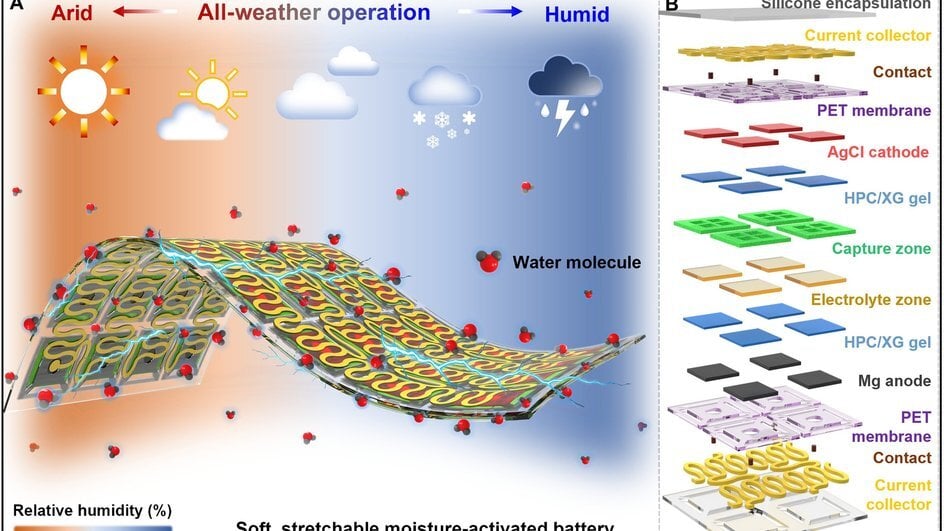
This battery maintains its functionality even when subjected to deformation due to its unique structure—its cells resemble pangolin scales that interlock tightly, minimizing gaps during expansion. Simulations have shown that this design evenly distributes stress during bending, twisting, and stretching, preserving energy density.
Tests demonstrated that the battery can power a wireless Bluetooth oxygen sensor for 30 hours, matching the duration of standard batteries. It is lighter than many commercially available alternatives, and its materials are biocompatible and biodegradable, making it a safer substitute for lithium-ion batteries.
Additionally, the battery features an emergency self-destruct mechanism. A dry mixture of aluminum and iodine is stored in an isolated chamber beneath the cellulose membrane. When subjected to external pressure, the membrane allows moisture to enter, triggering a reaction that destroys the device within three minutes. This function was tested using a wireless gas sensor.
The inventors believe their creation is not merely a scientific proof of concept but a practical solution. The technology is already ready to power IoT devices and medical equipment, paving the way for a new generation of electronics.